Back in ~2016 I deleted my Facebook account, because it was a horrible place that brought out the worst in people. A few days ago someone alerted me that my account was live again and posting weight loss scams.
So I logged in and changed my password and deleted my account again.
Facebook tells you that it will take 30 days to delete your account.
This is obviously user hostile bullshit.
Meanwhile somehow the scammer is still posting weight loss stuff on my account. Feel like I've jumped through enough hoops so I'll just let that person pollute Facebook more. Their problem now.
And I won't call them Meta, what a joke.
Everyone should quit, get ahead of the layoffs, useless company. Your work there makes the world a worse place. You can do better.
I deleted my account circa 2016 as well... Far as I can remember, they force you to suspend your own account for 30 days before being able to apply for a full deletion, but that takes 90 days, if at any point you log back in within the 90 days, the whole process is restarted. And this bullshit was only after you went through a squid game tier UI Olympics just to find the place where to kick off the process.
Facebook is one of the most end-user-hostile companies ever. No interface is what it seems to be.
Even downloading your own pictures is very difficult with the actual image hidden in some weird link in a maze of javascript. And the original one can never be downloaded - only a crummy scaled down version. It is a one-way trap.
I was contact by a recruiter from FB a couple of years ago. I knew I would never work there, but I talked to the recruiter long enough to get a comp number, and... suddenly my resolve to never work there took another day to firm back up.
That's mostly why, I think. In the end, I still said no, but it was much harder with the number in front of me.
People will say it's their compensation but there are many many places that pay well that don't make the world a shittier place. One doesn't have to sell their soul to the highest bidder.
"Pay well" but maybe not quite as well as Meta, and for our purposes I am excluding other FAANGs (except Waymo, sort of I guess):
- Roblox
- LinkedIn
- Robinhood
- Databricks
- Bytedance
- Box
- Stripe
- Two Sigma
- Lyft
- Uber
- Instacart
- Cruise
- Doordash
- Waymo
- Airbnb
- Pinterest
Companies which imo have a more positive impact on the world than Meta:
- Waymo/Cruise (autonomous driving)
- LinkedIn - close call, but a more professional social network with the intent of matching employers with employees and taking most of their profits from the advertising of those jobs without influencing global politics
- Stripe - value comes from payments processing for companies big and small which is a valuable product in its own right
- Lyft/Uber - close call again, but I think the disruption of the taxi industry and the additional options for transportation have really revolutionized how many people get around day-to-day.
Thanks for answering the question honestly. Looking at that list, I can see only LinkedIn / Databricks / Box / Cruise / Waymo as qualifying for "not making the world shittier" criteria. But quitting Meta to go work for another variant of social media like Roblox / Bytedance / Pinterest? Or Airbnb / Uber / Lyft / Instacart with lots of negative externalities by exploiting labor arbitrage? That doesn't really make any sense.
Sure, but that does answer your original ask. There are options, especially if you're willing to work for just slightly less (or in some cases you can still get a raise by switching) to work at a company that pays well and makes a more positive impact on the world.
> especially if you're willing to work for just slightly less
Well, in that entire list, following are the companies who don't make the world shittier: LinkedIn / Stripe / Databricks / Box / Cruise. (I will omit Waymo because its parent is Alphabet, which fails shittiness criteria).
Box stock is flat since 2015. Databricks / Stripe are private so no liquidity. So only LinkedIn qualifies for "slightly less pay but not shittier world". Though I agree that there is an option if someone wants.
It obviously depends on where you live and what you consider good pay. I get that. Personally, being in the situation of earning >2x the median household income where I live, which is one of the HCOL areas in NA, I consider myself unimaginably lucky. But that level of income isn't uncommon here for senior devs.
Did you go into the profile and find where it lists signed in devices and log them all out? It’s buried in there somewhere but they don’t automatically do it when you do a password update because they’re afraid of causing any friction in the process of browsing their ads.
To be fair, it's common for people to want to 'undelete' their account, so that's why they have a 30 day grace period. I can easily imagine the opposite situation where someone says deleting with no delay is 'user hostile bullshit'.
100%. after all the evil they did in the world i dont understand how are they able to retain so much talent working for them. do people dont give a f* about their impact to the world? many shake their heads after someone exposes engineering team working in rusian army configuring Iskanders yet the same people work for facebook that spreads worst dissinfos, sells user data and basically plays parts in genocides.
i really don't understand why people don't like facebook. they're no worse than apple or your ISP (now they're truely evil).
dissinfo? just unusubscribe or don't follow that account? do you really want facebook censoring everything you can see or don't see based on political correctness? or some other filter?
and how is it "selling user data". I've always found this to be wholly inaccurate. it's targetted advertisement. do you really prefer untargetted advertising?
I'm no facebook fanboy. personally i don't use it much. i've read articles on the matter but they never make any sense. Is there an article somewhere that explains all the vitriol towards facebook, because i really don't get it.
Ctrl+F "sell" doesn't have any matches on that page. It seems like FB was using Onavo to spy on people for its own competitive advantage. That's obviously extremely shady and unethical but it's not the same thing as 'selling'.
I don’t think they are some evil scourge on humanity, but I also don’t like them and won’t work for them.
For a few reasons: they copy/steal or acquire all their new ideas, have diluted most of the real human element of their social network products into “promoted” content or “recommended” reel spam - leading to an “Instagram culture” of flexing and showing off to gain an audience.
But I do agree with you that “misinformation” and user data issues are blown out of proportion.
Re: “no worse than Apple”: Apple implemented features to make my phone give me less notifications by default when I am driving, at work, or close to going to bed. These features are helpfully turned on by default. Contrast this with Facebook’s design philosophy of increasing the amount of time a user spends staring at their phone at all costs.
Apple’s tracking prevention has put such a huge hole in Facebook’s panopticon-like internet-wide surveillance scheme that it is almost certainly one of the causes of these layoffs. You ask “who wants untargeted ads,” and it turns out, when you give users a choice, the answer is “most people, actually.”
There is no rational basis for saying that Facebook is “no worse than Apple.” Facebook is an actively malign force in society, worldwide, and we would all be better off if they shut down completely.
here are the reasons I hate apple more than facebook:
1. they force developers to buy mac os x to work on their platform
2. their app store monopoly is extremely hostile towards developers and thus democracy
3. they force me to enter my financial information when I sign up with them
4. they won't allow me to use their products without an apple account which means I need yet another password to sign in
5. they won't even allow me to download apps without signing into my apple account.
6. the whole apple ecosystem kinda locks you in.
7. planned obsolescence, which I really hate.
On the other hand for facebook. I can just ignore it completely for months on end and easily block all my notifications or emails from it. or block them one by one if I choose. if i dont like the feed, then I just don't spend time on it. nothing about facebook isn't easily circumvented whereas apple has a death grip on you, as long as you need to use it's products.
Because companies paying as much as Meta have their own dirty laundry. Google, Wall Street, Crypto... you name it.
> do people dont give a f* about their impact to the world?
It is very hard to connect dots to Rohingya genocide when your job is to tune machine learning models to increase the engagement with feed. And if one starts going that rabbit hole, again, one will never be able to find a good well-paying job.
People have to eat. Maslow's hierarchy of needs and all that.
Fact of the matter is Meta has problems almost no one else has. Acting like people will choose less pay and boring work over interesting work and more pay on a moral basis is a little naive. But I see you apparently have a political axe to grind. Meta is not a morally acceptable place to work I agree. However, if you were offered 350,000 USD to work on something hard like a compiler or a data pipeline designed to ingest petabytes of data I'm sure you'd at least think twice about it. For example, you could work at Meta and use the money they pay to fund organizations you support that run counter to Meta's mission. This all not even mentioning having Meta on your resume is basically a golden ticket to the industry for the rest of your career.
Deleted my account around them. I've just valued privacy more as I've aged. I don't want to "connect" with people I have no interest in connecting with.
I deleted my FB account ages ago and two years later a friend pinged me that I should look at my FB account. I was like what account? I never looked there afterwards anyway so not sure what was going on.
Did you revoke all your oAuth tokens? While a password reset should do that (as should account inactivation) I wouldn't put it past FB to goose retention numbers by not automatically doing this.
In the first instance you probably did not delete yor account, you just declared that you are deceased or some obfuscation of that sort (talking from personal experience - and I am not calling in from the dead yet 8-)
Two rounds of layoffs seems to say something that one round doesn't. You would expect that all things being equal there is never a scenario where it is better to do two cuts instead of just one. So why?
a) things were much worse than realised. Maybe but it would have to be a big shock coming because Meta's general performance has held up OK, certainly nothing that would warrant this.
b) HR reasons? some sort of requirement that prevented them doing it all at once? Someone said that this time around they were doing masses of performance reviews. So perhaps the first wave were arbitrary cuts but they couldn't do the second without actual evidence of poor performance backing it?
c) change of plans? Mark wants to go all in AI instead of Metaverse and this means grand restructuring of his whole workforce? You'd think that would be very evident from which teams get laid off (we'll see).
I see no evidence of that. The recent announcements are at best a re-org, or worse a cleanup of three+ reorgs where FAIR and others were subsumed into RL-R.
It is clear that The Meta leadership doesn't really understand what they are doing. The first cut I suggest was designed to send a message to investors that meta is "serious" about something. I assume that this second cut is because not enough people left of their own accord.
However none of this is actually a change in strategy. Where are the product changes? where is the announcement of key priorities for the different Apps? are they going to start putting users first? or just add more shit into each app until something sticks?
The key problem Meta has is that they only have one effective leader: zuck. Everyone else appears to be underwhelming.
Boz: arrogance personified. None of the misteps in the last 4 years are ever his fault. It was market forces that meant that raybans failed, rather than releasing them before they were finished. the quest pro didn't sell, not boz's fault. The market wasnt ready for a capable device with absolutely no software support for the new features. Want to join your friend in a VR game? sure! just perform 15 clicks and wait 7 minutes. No not those clicks, no you need to press the hidden sub menu silly! Oh, no, remember you need to have an OS update first. 10 minute update tax!
Mosseri: Pivoting Instagram to video, because tiktok. just push push push. Oh wait our cash cow users are pissed off, ok, roll back. "there was no way to forsee this problem" despite everyone telling them it was a horrid user experience.
Blue app: Lets just push random shit into your stream, don't worry we'll roll out the user controls next half. Don't like the content? tough my metric is to get more shit in your feed, if you don't like it, its not my job to fix it, thats someone elses.
Because copying China isn't a great way to devise policy. China bans many things that are good and should remain protected in the US.
I don't use Tiktok or have a strong opinion on it specifically, but I really disagree with the notion that we should reflexively ban things because China banned something similar first.
Instagram has gotten to the point where I just have absolutely no interest to continue using it.
Mostly it feeds me soft porn, and my friends have kind of posted the same things over and over, which has become kind of boring. Food pics, workout pics, whatever.
It's gotten to the point where I'm just actually bored with the platform in general, not necessarily the content.
Facebook, I just have zero interest in going anywhere near it, it's so, so, so boring.
Instagram will feed you more of whatever you are following or tapping.
I have noticed that if I don't use Instagram for a few days I end up with generic, lowest-common-denominator videos. Scantily clad females, bar fights, car accidents, etc.
But if I start seeking out and watching the stuff I actually like, the feed updates itself within a day or two and I get content that I actually want to watch.
I just can't be bothered seeking out "stuff I like" on Instagram anymore, mostly I've seen it before etc, just feeling like I have better things to do lately.
If I actually want to "watch" something, I open Youtube, seems to me like the content on there is 10x better.
I follow aviation related accounts so I see pictures of planes on my feed. I did have to stop following hashtags because people tend to spam bikini pics there
>Their only bet is to lobby congress to ban tiktok.
Good point, the only way for 'Meta' shares to go up and for investors to have some confidence in 'Meta' is by Tiktok being banned in US (and other western countries like EU, Canada etc).
Automatically, the advertising money which was to go to Tiktok will go to Instagram (via Reels).
I was thinking more about the EU actually. After banning TikTok, it won't be long before someone says, "hey, Instagram steals people's personal data too."
Banning TikTok is such a pointless exercise. So what, it just means that another service will pop up and take its place under a different name. The government can ban it all it wants, but it's not going away. Too simple of an app.
Okay but that’s what the government hopes will happen… They don’t object to TikTok the concept. They object to the PRC having influence or control either real or potential.
>It just needs to slow it down long enough for one of the US competitors to eat up their marketshare.
If I were Snapchat I would be making moves to jump at this opportunity. I feel they're positioned the best to take that market share out of all of the current competitors, for the simple fact they've kept their core UI & model virtually unchanged.
> Boz: arrogance personified. None of the misteps in the last 4 years are ever his fault. It was market forces that meant that raybans failed, rather than releasing them before they were finished. the quest pro didn't sell, not boz's fault. The market wasnt ready for a capable device with absolutely no software support for the new features. Want to join your friend in a VR game? sure! just perform 15 clicks and wait 7 minutes. No not those clicks, no you need to press the hidden sub menu silly! Oh, no, remember you need to have an OS update first. 10 minute update tax!
I wonder if companies like Meta will finally start caring deeply about performance of their products, and will switch to software paradigms which preserve performance (see for example latest Casey Muratori talk on slowness of Clean Code, and also his "40 million lines of code" talk). I mean, the forced updates of software, and how long they take, is a major complain of users of many modern entertainment devices (the VR googles, game consoles etc.). They long updates are of course caused by "the stack" being a pile of uber-overcomplicated shit, which was quick and convenient to develop, but now is harming the product.
Abstraction costs performance in many cases. But you sometimes want/need that abstraction. But on the other side of that is drop a comment in there how to abstract it if needed but do not abstract it until you need it.
And 'updating' that is my favorite playstation game! It seems to be what I do every time I turn it on every few months.
I thought this was Hackernews and people fixed tech inconveniences with random scripts! I’m sure someone on here could hack together something to check for updates and run the update or automate that process with a click from your phone.
I agree, but sadly it's getting harder and harder to do that sort of thing. It seems that almost inevitably, along with those fancy framework abstractions come tighter restrictions on how much the user is allowed to do things which are not explicitly supported by the UI. All in the name of "security", of course.
With the PS if I leave it alone and powered on it will take care of itself. But I turn it off so it does not use as much power. I have enough other items in my house turned on to heat it up :)
> uber-overcomplicated shit, which was quick and convenient to develop, but now is harming the product.
Its not even as contrived as that. In meta, you don't get points for incremental improvements that make life easier for users. You get points for making a new widget that improves a single metric. That metric will most likely be something sub-team related, with little to no impact on the over all team or even product.
That is exactly how Microsoft became so dominant in personal computing starting in the 1990s. While it's true that Microsoft did some unethical things, they succeeded primarily because Novell, WordPerfect, Borland, and IBM all made huge strategic errors and essentially knocked themselves out of the game. They missed inflection points that transformed the entire industry. Microsoft's errors were all smaller, and easier to recover.
It's actually kind of amazing that there's not any real consequence to making that bad call. It sucked up a lot of energy, lots of people tried to stake and early adopter position in the metaverse and it turns out everyone just didn't want that.
I think they could have made more money if they built games into facebook. At probably a fraction of the cost really.
Yes, of course. It's not the sort of consequence that would be meted out by a parent, but it's appropriate. Facebook is much the poorer for it, as is appropriate for them trying a new thing.
I think what would be awesome is if he just opened it all right up, the specs, the hardware, the whole thing. It would spur a bunch of hackers and cool innovation.
Without doing something like this, I don't think it will go far.
Not at all! Done right, we could have ended up in a sci-fi future strapped to our VR headsets all day long. But the real life, physical technology is just not here yet (maybe it's impossible and never will be), the software they invented for their lacking headsets is disgustingly bad (Horizon Worlds) and there is no nameworthy content.
I assume his advisors and tech leads all pulled the wool over his eyes and sold him their lofty dreams as tangible reality.
> Done right, we could have ended up in a sci-fi future strapped to our VR headsets all day long
When I read this phrase, the spaceship from Wall-E comes to mind. But in reality, it would probably look a little bit more dystopian than what Pixar imagined...
Most people would say they HATE this future, but most people would LOVE this future. As passive infotainment consumers, stereotypical scroolers, they are already glued to TikTok, Instagram, Facebook, reddit and whatever other digital dopamine dispenser and skinner box there. Significantly improve on that with pleasant, increased or even full immersion and you got the next big thing.
...they say, posting on HN, a slightly watered down dopamine dispenser brought to you by the people that made Reddit happen.
I still think VR might be a hard sell for most people. As dumb as large groups of people may be, it's clear that people are ditching FB and slowly backing away from a lot of social media. It's tricking out that it's not always a great thing, and there is legit buy-in from huge chunks of the Left and Right to restrict what social media does.
> ...they say, posting on HN, a slightly watered down dopamine dispenser brought to you by the people that made Reddit happen.
I by no means wanted to exclude myself from the groups I so derogatively named. Hacker News is pure infotainment to me. The quality is above reddit though, but that's not a high bar.
> it's clear that people are ditching FB and slowly backing away from a lot of social media
Are they? To me it looks like TikTok addiction and stupidity is continuously peaking.
I'd say HN quality is way way better than Reddit, entirely due to the audience. Reddit is very much anti-knowledge, anti-solution, anti-reason whereas HN features intelligent discussions, often supported by facts.
All of this stuff is locked behind AR/VR glasses that are close enough in size, shape, and weight to normal sunglasses. If someone manages to build that, it'll be the biggest thing to hit computing since the smartphone. If not, it's all going nowhere.
Your characterization of him is correct, but he didn't accomplish what he did through sheer luck and marketing; he also had a really good sense of what (average) consumers wanted in a technology product, which his competitors seemed to mostly lack.
He failed to produce his own brand. The only thing that comes to mind when anyone thinks about Mark is "Facebook scandals", "looks, moves and talks like a reptiloid/robot" and "the mataverse that no one wanted failure (no legs!)". I bet he wishes he would have been what Elon Musk was, someone with pretty much his own cult. Elon Musk still has his cult followers and online knights despite his increasingly erratic behavior and general unpleasantness.
The only thing that is vastly better in VR than in reality are horror games. While one can laugh on how silly/unfrightening the movie nightmare on the Elm street is, a proper VR jump scare can easily lead to a heart attack when following some quiet period of gameplay. Not sure if this was the intended effect as it would likely reduce the number of consumers once for all.
D) with an organisation this size, it’s impossible to do the cuts once and for all the people you need to cut, because the communication and reporting lines will get completely disrupted. If they know they need to cut 20%, they can’t do that at once as the business would collapse. Doing 5% every quarter means there’s time to absorb the changes.
Snow Crash is a a dystopia because of hyper capitalism not because of the metaverse. It's like worrying about space travel because 2001 had a runaway AI.
The metaverse did empower malicious advertisements to selectively target people (and put them in a coma) in Snow Crash iirc, so maybe it's really just a pivot deeper into that side of adtech.
The physical world of snow crash was a dystopian hellhole. The metaverse of snow crash was still step up from that physical world, at least for the protagonist. They were a corporate pizza boy slave in the real world, but in the metaverse they were cool and had power and agency.
HR reasons are more common than you'd think. There's only so much HR and legal power to go around and it sometimes is easier to plan layoffs in multiple stages, rather than go for one big one.
It is exactly Mark’s plan. He called 2023 “the year of efficiency”, meaning that he wants to flatten the whole organization and get closer to startup velocity (and cost). He communicated this theme during performance reviews, as suggested by the article.
it seems striking that Carmack left pretty much with that criticism and Mark is now probably executing exactly what Carmack would have prescribed. It'd be interesting to correlate how closely the thinking around this second wave started to when Carmack made his announcement.
It takes a certain kind of cold detatchment to hire 5,000-10,000 people to r&d and build the foundation of your next big thing - drain every ounce of life out of them then discard them on the heap a couple of years later.
While I agree with your sentiment, this is a nasty business, I would like to think we also all know the game now. Do people go to work at Facebook[1], Amazon, etc., expecting to still be working there long enough to see their kids graduate and go off to college?
[1] I'm still not going to call it "Meta" any more than I am going to call "Star Wars" "Star Wars IV: New Hope".
most people at these companies don't last very long. if you doubt that, just take a look at the average person's linkedIn or resume. You'll see the average tenure at a tech company is about 2 to 3 years.
While many people do job-hopping because they might get more money etc., others value stability, short commute, a project they like, their colleagues and more money is not as enticing. Even others found a cushy job they don't want to lose - many reasons to stay.
The alternative for many would have been something closer to a startup. In the case of Oculus - employees probably did quite nicely out of the company being aquired by facebook (?).
I guess if you are working on greenfields tech - one should avoid the big tech co. You have no real ownership of the innovaton and nobody is going to come along and buy you out if it goes well.
Like many tech companies during zero interest rates, they over hired and did not anticipate interest rates going up so fast. At least these employees probably made a ton of money.
This has nothing to do with interest rates, none of these companies are borrowing to hire.
And Meta, Amazon, Salesforce etc are only shedding excess pandemic hires. If you look at a graph of hires over a decade, the pandemic shows a huge blip up, and these layoffs correct that.
> This has nothing to do with interest rates, none of these companies are borrowing to hire.
The interest rate connection is that investors buy the company stock (driving the price up beyond what's reasonable given the underlying business health), because the alternative fix rate instruments offer negative return.
It does if they use their stock price as a benchmark, which they do if it is a part of their compensation. Higher interest rates push investors to sell their Facebook shares and buy bonds instead. This means that Facebook needs to earn higher profits in order to pull its stock price upwards. Low-IRR projects are eliminated and with them the people who worked on them.
>And Meta, Amazon, Salesforce etc are only shedding excess pandemic hires. If you look at a graph of hires over a decade, the pandemic shows a huge blip up, and these layoffs correct that.
I think you're arguing against yourself.
Why do you think there was a huge blip up during the pandemic? Because their revenue was increasing at a faster rate, so they hired to sustain the increase in revenue and they believed the growth rate will continue. Why was revenue increasing at a faster rate? Two reasons. First, zero interest rates meant that people had more money to spend than before. Second, staying at home meant that people didn't have much else to spend their money on except tech/internet.
So, if you know you’re doing research on a new product that as far from a sure bet, don’t you have enough self awareness to save a fair amount of your outsized Facebook compensation, sell your RSUs as soon as they vest and diversify and be ready to interview?
Or am I just old and not naive and start doing the same thing they do I got my first check + prorated sign on bonus when I was hired at BigTech almost 3 years ago?
HN is probably not the best audience for this message. But I obviously disagree.
People don’t become doctors because it’s insanely hard, stressful, time-consuming, and expensive. What we need there is not more money, as doctors also have high salaries already, but a reform in the system to make it more appealing to do the work.
I’m not sure what you mean by “more engineers, more visionaries”. Are workers at big tech companies not engineers? And how does reducing somebody’s salary make them a visionary?
More likely is that somebody makes a lot of money in a big tech company then can afford to quit their job and start their own company. Aka, they can become a “visionary”, like you suggest.
Then why did he hire so many people if he wants to run a flat org at "closer to startup velocity (and cost)"?
Wasn't he the one in charge since oh... I dunno... Day 1?
Exactly! If you look at HN comments you'd think they all live this perfect life, never introduce bugs in their software, never make poor financial decisions (including mistakes of omissions).
The whole comment section becomes a cesspool whenever Meta/Mark or Elon is discussed
d) different set of roles are going to be cleaned up? According to rumors meta is flattening and requires many managers to switch to ic roles with mandatory coding/delivering. Could be a chance to clear the house there too. Also perf review results, won’t be surprised if not only individual perf was reviewed but whole teams/orgs.
In general, I think, that Facebook (and rest of faang/ms/etc in similar proportions) now are building plans what/whom they need to cut off if they want to operate with 50k/35k/25k/15k total headcount.
Curious to see if the 2nd phase applies more to countries they operate in that don't have "at will employment" style legislation, it might go some way to explaining the two phases. That would fit into your point b).
IIRC, the first set of layoffs largely affected the US a lot more than Europe - its a much more involved legal process generally to perform layoffs in cities like London vs their US offices and often can't be done as quickly.
I wonder what effects this uncertainty will have on an organizational system. With multiple rounds of layoffs, talks of 'flattening', projects being cancelled, internal transfers being frozen, hiring being frozen, when does an organization finally become 'healthy' again? When are the right people in the right places making the right decisions again?
Does an organization that has so much capital need to even care about organizational strength?
I've noticed more uncertainty, less comradery, a general malaise, lack of motivation and a lot less trust in the organization. A very very different feeling to a year ago.
This was how Microsoft was seen in 2013 as Ballmer stepped down:
"Slumping stock price and unimaginative vision has left Microsoft marooned between a fading past and an uncertain future"
An unimaginative vision is a common result of mass lay-offs. The ones that stay behind do not dare to take risks and prefer to stick to the status quo. Only after
Satya Nadella took over, did Microsoft start to recover.
I'm usually not one to say companies shouldn't take on risks to expand into new business areas, particularly not in times where the core product is bleeding lucrative users... but here it's the same shit as with Twitter prior to Parag Agrawal's term or with Elon Musk's dozens of ventures.
It's one thing and bad enough if board members have sometimes dozens of posts... but Zuckerberg, Musk, Dorsey all show it's not a good idea when an actually active C-level exec has too many things on their table. And it's especially not good if they use company resources for their personal pet projects.
And it's especially not good if they use company resources for their personal pet projects.
Good grief.
I guess if you are a CFO, or finance guy, sure.
But a "pet project" is conjoined with passion. And R&D, and testing the waters in other markets, is what causes true motivation.
People often complain that big corps can only innovate via acquisition. Yet, this comment is complaining that big corps are innovating by... startup methods!
For what does a startup do, other than live as the pet project of its founders?
We should encourage CEOs of large corps to go out on a limb, to R&D, to bring change to the market, to explore new growth streams.
> And R&D, and testing the waters in other markets, is what causes true motivation.
There's a difference between legitimate R&D and pulling Tesla engineers to put out fires at Twitter. The latter is a blatant abuse of Tesla's resources and to be honest it's a miracle how Musk has not gotten under serious fire from at the very least the Tesla board or a lawsuit by shareholders.
Sounds like faangs are becoming more like banking environment where few % layoffs are often happening few times a year. It still sucks to be the one affected and over time it sucks out a lot of positive energy
I don't know when they made that decision but a recruiter contacted me from meta last week. I wonder how far do people go through the hiring pipeline before the "stop the engines" signal arrives. Hopefully not after the offer has been accepted.
It may continue for another few weeks after „Stop engines“ signal is received, because recruiters still have their jobs and team leads will tell them: „Let’s keep recruiting funnel warm, while I’m checking if that signal really applies to us“. Until every team with an ambitious team lead is told that they are not special and they really should stop, they may still continue at least talking to people. And some may even got their budget after few rounds of negotiations, so this strategy will make a lot of sense for them.
Yeah, some recruiters are going to keep recruiting until they're fired. There's always a chance that somebody needs a warm funnel and then they'll be the ones kept around when the others are laid off.
Just a personal anecdote, I found Facebook's recruiters to be the absolute worst. The facts and figures of the position kept changing, and I spoke to three of them, and came away with zero confidence in their abilities.
It depends on organization, but in-house recruiters do not always have to interview people for specific positions. Employer branding, acquiring leads through meetups and conferences can also be part of the job.
exactly, in my experience, HR departments (at least recruiters) are among the first to be fired when things turn down - who needs to pay recruiters if you aren't hiring? - much better if you are worried about your own job to keep busy, and advertise and interview people for non-existent jobs then to sit on your hands all day with nothing to do. Hopefully the 'keeping busy' will save your job, if your manager needs to pick from a few dozen recruiters which ones to toss and which to keep.
Yes they do. The trick is not throwing out the baby with the bath water. Elon Musk got a lot of criticism for how he handled layoffs at Twitter. But he did provide clarity and then ripped off the band aid. Notice how things have gone quiet around Twitter lately. IMHO, it wasn't nice but what remains is probably a healthier organization and a fairly stable team. A lot of people left in the process and that was always going to need to happen. But what remains seems to keep things going and they can now think about a future and work on that. He could have done it in a more respectful way. But doing it quickly was actually not a bad thing.
Facebook is dragging it out and people are unhappy. Having seen this from the inside, when companies are going through a lengthy process of repeated layoffs, people get nervous and lose trust in management being on top of things (because they obviously aren't). At some point people just start leaving by themselves instead of awaiting the next round. Or worse, they mentally check out and patiently wait for the compensation that comes with their layoff. Either way, they stop being productive team members. This creates a toxic situation that is hard to recover from.
IMHO Facebook should be more decisive and rip off the band aid a bit faster. They have a staffing problem. Too many people that were added that aren't delivering whatever Facebook had in mind. They are spending billions on things that aren't working very well. And throwing more money at the problem has stopped working. It's just costing them more money to do the same things they were doing.
Huh? Twitter has had almost monthly rounds of layoffs, including one a few weeks ago that took out some fairly high profile employees. They also have arbitrary firings and people being let go without being told [1].
I'm certainly not going to argue that Meta is going about this in a good way at all, but it is hard to think of a worse example of doing it "well" than Twitter under Elon.
Someone counted 3 or 4 -- I forget -- separate rounds of layoffs after Musk said Twitter was done with layoffs. That's many things, but "providing [sic] clarity" it ain't.
edit:
> Musk has done at least three rounds of layoffs since his promise to stop doing them in November. [1]
Twitter kinda looks like a billionaire decided to pay a ridiculous amount of money for a company, just so he could destroy the livelihoods of thousands of people less fortunate.
I wonder what he thinks people think about him when they read this real life satire? There is an employee who doesn't know if he got fired or not and the CEO of his company now publicly wants him to explain what kind of work he was doing. Nobody even knows why: Will Elon decide whether this guy will be fired for real or get back his work pc access depending on his answers? Why is there no company internal way for Elon to figure out what someone does? Why does Elon engage publicly?
This is stunningly bizarre and such a bad look, the definition of a "shitshow".
I think Musk is a breath of fresh air from the sterile, managed, corporate-speak drones. He already proved a lot of... "experts" wrong about the imminent implosion of twitter after he got rid of a bunch of people. I'm very interested to see how things go in the next few years. Here's his side of the story on that.
I have worked in companies with a lot of dead wood in relatively senior roles. They may have done good work in the past, but they seem to stop doing much actual productive work and instead just kind of insert themselves into important projects and meetings and set about trying to make themselves sound indispensable. Yet they produce very little tangible output and their work can't be explained without vagueness and buzzwords. Leading efforts and driving changes and steering modernization and managing the paradigms, bringing stakeholders together, architecting solutions.
They're hard to get rid of for whatever reason. They've built little fifedoms, they have a reputation, they're very good at hobnobbing with middle management, or other dead wood.
Some orgs absolutely could benefit from a fresh pair of eyes to come in and have people justify their positions, and have the confidence and risk appetite to make some calls.
Now I don't know if Musk is telling the truth here, or anything about that ex-employee, his work or background. He might be a great worker who was well worth his salary in value created for Twitter. He could also be one of the other kinds, that failing orgs desperately need to rid themselves of. His twitter pitch is not highly confidence inspiring.
Twitter allegedly shed about 80% of its staff since Musk took over. Which is frankly staggering that it is still able to operate with 4 in 5 people in the company gone. Maybe that is cutting too far down to the bone but there has been no immediate implosion or collapse. Things still have a long way to play out, but clearly he did not throw darts at a board and fire random people or all the most productive ones if it could get that far.
Are you somehow unaware of the regular reliability issues (6 incidents in 2023 alone), downtime, collapse in revenue, advertisers erosion of trust, etc?
Personally, I couldn't classify that as 'operational' - but maybe I just have high standards and expectations
Twitter used to not work for me. I would actively avoid clicking on links to tweets as they would reliably not load on the first try, refreshing wasn't reliable either, and was quite slow.
I am today an active user of Twitter, and never have these issues anymore.
I don't use twitter much but I've always found it quite incredibly unreliable (for what it is and how many engineers they had working on it). Something was always "going wrong" with it. I haven't actually noticed any difference post-Musk. I'd easily believe if you pulled up stats showing it did get worse, there's simply been nothing you'd call an implosion of the service. It used to kind of work most of the time, and it still does.
I haven't really looked at financials. It's never been what you'd call healthy though, sans SV-bubble. I have heard they lost a lot of revenue since Musk took over but I'd imagine there has been a collapse in opex too so it's difficult to judge that one way or the other.
As for trust, I think a lot has been gained as well due to more transparency about their involvement with government censorship programmes. Again hard to really chalk that up one way or the other.
I'm not saying Twitter has suddenly become the golden goose under Musk, or that no technical operational aspect of it suffered after laying off 80% of their staff though, so this doesn't really address my point. My point is Twitter must have had a vast amount of positions that were not providing value and its actually refreshing to see a CEO go in and ask people to explain what they do, take bold action, and take ownership of those decisions.
The meek, managed, MBA, CEO style is to release a canned statement saying how sorry they are and how horrible they feel, and delegate salary or head count reductions down the line which actually doesn't help much with the dead wood situation and can even entrench it because they're often in lower level executive positions themselves.
My company has recently been through a round of these job cuts and we fired good, productive, very long term experts and immediately had to move people in other places to fill their exact positions (badly, because they barely worked with that code before and have to learn it all). Why? Because they worked in different branches of the organization. They fall under different VPs, and the edict said that everybody had to trim X%. It had nothing to do with what work they did, targets had to be hit so they had to go.
I would have killed to be able to take it to the CEO and be asked to explain what those people did to justify why they should stay on. That's why I find Musk a breath of fresh air. Not because he posts infantile memes on twitter or is rude to employees -- I don't think that twitter convo was very tasteful, he could certainly stand to improve how he goes about things. I just think his approach to running companies has some merit.
Works more or less the same as before really. There may be some differences but let's not pretend that many alleged experts were completely wrong in their predictions of imminent implosion. And I wonder how much expenses have dropped.
Corpspeak sucks and Twitter probably had more people than it needed. That being said, the solution to that is definitely not to hire someone who decides the final word for an exec is to post offensive memes on your account and shame individual employees after you fire thousands of them. The cuts weren’t quite random, but they were pretty haphazard, and a large part of why Twitter is still standing today is the work that went into improving it in the last decade, rather than smart decisions from Elon.
I think the problem with this take is that even though he's "shaking up" corporate culture, it's not, like, in a good way. Just randomness. More fun for the public to watch but I don't think we have many signs that any results are good.
Twitter sucks now. Even its boosters are using “the service didn’t permanently collapse within 80 days of settlement, see?” as their metric of its success.
If it sucks now it sucked before. And the self-proclaimed "experts" who were certain it would imminently implode don't get to avoid being wrong by indefinitely stretching what imminent means or watering down what implode means.
Watching a grown man beg Elon musk for his job on a social media platform is not something I expected to ever see. It's been two weeks- if his paycheck didn't come through, he has his answer. Obviously a s-show led by Elon, but on LinkedIn especially I am seeing a lot of posts where these ex-FAANG employees, who usually score severance measured in months rather than days or weeks, and who were already raking in a $250k+ salary anyway (if you count bonus/RSUs), are so desperate to find another job "ASAP" as to make a post on LinkedIn to... try to get other people to find a job for them? The entitlement is rampant and I see no real difference between this Twitter conversation (if you can call it that) and the posts I frequently see on LinkedIn.
I'm out of date but in the past if your company was acquired and you were retained, you had to stay X years at the new company in order for the acquisition to be considered complete and you to get your complete payout. Dude probably wanted to know am I actually fired, because, then you need to, you know, pay me for my company? Elon tried to ghost dude, but old boy's got receipts is my guess. Elon just spent $$$ to save ¢¢¢. But maybe acquisitions/retained founders is different today. Elon rules though fake 'Twitter transparency' that lacks all nuance and detail but does have 200% more memes so who knows.
It's strange. I know the colloquial wisdom is that it's not only NOT strange, but a good idea... but it's strange. It's usually ex-FAANG who are likely millionaires from a net-worth perspective, who were given weeks or months of severance, who would realistically have little trouble finding another job given their resume, yet they will compose a giant LinkedIn post about how woe is them and they need help finding another job - before they've even lifted a finger to find a job themselves. It belies everything they purport to be (e.g. "good enough to get a job at FAANG"- churned leetcode to pass the interviews, etc.), if you ask me.
Sure it is. He was asking Elon whether he still had a job, after being locked out of his account and not being paid for 2+ weeks, then he tweeted a litany of contributions he was making to the company to sell himself to Elon, whether that was his intent or not.
I'm not defending Elon, the whole thing has been a dumpster fire.
By all accounts Twitter has lost something like half its revenue and yesterday had regressed technically to the point where they couldn’t serve a hyperlink.
Twitter already had a much lower workforce than FB or Google, etc. After a the cuts it’s even smaller so I guess there is just way lessons people who can or are interested in talking about it.
I tried the new PS5 VR2. It’s definitely better than Oculus Quest.
Makes you wonder what Facebook has been doing with all those billions spent on VR when Sony is able to produce a better product with a fraction of the investment.
Meta hired people that specifically had experience in hardware, wearables, and games for this big bet. Sure, you can say that maybe Meta's infrastructure is in it's infancy in this field, but so is everyone else's because, quite literally, Meta was the only (big) player in this field in the first place.
Except Meta also filtered with the same filters they used to form an engineering org around serving ads.
I have pretty extensive experience in the embedded Android space and have worked on products everyone here knows, Meta reached out to me very excitedly, and when I let the recruiter know I don't do Leetcode they assured me the coding phone screen was a merely a formality and I'd do great.
It took all my willpower not to leave the moment the interviewer dropped some generic LC merge sorted lists problem, though I don't think I did was that much better their eyes (poked at it for about all of 5 minutes, called it, and asked them some questions)
They actually tried to set me up with a second phone screen but I declined, even on the principle of it, I don't like working at places that filter by LC. In cutting edge stuff like wearables especially, I'm sure you'll find a ton of people with no time for jumping through LC circus. I'm sure I could take a few months and grind out those problems in my sleep (or rather I've been told that), but I'd rather work on interesting and novel things.
merging sorted lists is not a leetcode nightmare interview question though, if you can't manage it in an interview, chances are you can't program very well IMO
OP didn't go into detail about the problem, so we have no idea what the actual problem or solution was. Empirical research has found many people don't do well in high stakes problem solving situations while being watched (shocking).
Many people also don’t do well in high stakes problem solving situations even when not being watched.
I’m not suggesting OP is dumb, but if someone is setting hiring criteria and thinks they need X skillset judged by Y, I think there’s a good chance they’re directionally correct.
I get it, I’ve bombed interviews I was excited about and rationalized it anywhere and everywhere. Once I started hiring folks, my opinions evolved significantly.
How else do you hire someone out of a pool of people that are all knowledgeable and likable? A bad hire, even if they’re super smart and just the wrong fit, is worse than not hiring anyone at all.
If you climb the management ladder, you’ll likely be graded on your org’s hiring outcomes. If 10 people all seemed qualified, I’m going to burn down the risk as much as possible. If I’m wrong 1 time for this, but it not obviously wrong 9 others, I’ll call it a win.
For context: this is coming from tiny startups to billion dollar companies and different things in between.
What if there's solid evidence (e.g. visible work in open source) that all ten can code? The problem is not that coding interviews exist at all but that they're mandatory for all levels and roles. At L5+ coding isn't even the most important skill, so LC-style coding interviews introduce a risk of false negatives without providing any actually useful information. BTW those false negatives occur disproportionately for some demographics, and it only takes a single mention of "culture fit" to make one wonder if that's the whole point.
I mean the bubblesort of a solution is to simply concentrate the two lists and call sort on the whole thing. And then move into the next ticket. If called out during code review, yell the words "premature optimization" repeatedly and then storm out.
That's for after you get the job though. During the interview you'll need to be a bit smarter and more practiced with algorithms.
I saw the question, and thought maybe the recruiter was being literal about it being a formality...
So I asked "is a naive implementation fine"? The answer was a quizzical "... well I guess we could start there? But we're probably going to need at least <insert Big O notation for time> and preferably get to <Big O notation for time and space>", so I wrote out a completely naive implementation and switched to questions.
-
But you're right, I can't program. Not memorizing elaborate cache-unfriendly vectorization-unfriendly algorithms has made me unhirable.
There was a reason they were excited to talk to me, and I thought it was an impressive career of programming to solve hard problems that started from writing assembly games for calculators in middle school... but who knows, maybe it was my charming smile?
Luckily my smile got me hired by a company that's paying me a FAANG salary but hasn't had to lay off thousands (knock on wood)
The problem is that if your company is routinely hiring people on their accolades (or just trust me bro) alone, you'll eventually end up with people who _can't_ merge linked-lists. The FAANG model of making people solve BS programming puzzles at least guarantees that a person is a try-hard or is capable of slinging some code, which its own issues aside is better than the baseline of charlatans who don't know anything. Outside of FAANGs I've routinely interacted with fairly senior engineers who just could not code, period, full stop. Maybe you can scale to 100s of engineers without the stupid interview gimmicks, but you won't hire 1000s engineers who _can_ actually code without ascertaining that they posses some logic, and if their rote memorization is so good as to be indistinguishable from general intelligence, so be it, they're passing the turing test :)
I hold myself to the standard of knowing enough the problem space before I interview people that I can open an editor and come up with domain specific problems that anyone who's doing what they claim they're doing daily can work through (crazy bar I know...)
> Outside of FAANGs I've routinely interacted with fairly senior engineers who just could not code, period, full stop
My first thought was "You must be joking if you think there are no L5s in FAANG who can't write code",but then I realized you actually think of writing code as literally being able to write statements in a given order... but that's such an insanely low bar that people regularly meet it by repeating problems over and over for a few months.
My bar for writing code at past a junior level is to be able to solve a problem with production grade code. LC almost precludes that between the time constraints and rigid solution set so people settle for "they wrote a guard statement against an empty list".
I just want to know that a new hire isn't going to ignore things like cache locality or not know what a memory mapped file is and try to load gigabytes of data into memory and parse the whole thing just to run their O(N) solution across 4kb of data.
I dunno? I ended up not working at a company that fired thousands, was grievously injured by Apple flicking a switch that enabled sensible privacy defaults, squandered Carmack, and is losing to ultra conservative legacy institutions in an innovation driven space?
And according to Levels.FYI I'm making more than the average person with a comparable title at Meta, maybe because the same things that made Meta excited made me attractive to other employers without the random cargo cult filters...
But hey, maybe I'm just trying to convince that recruiter who definitely wasn't laid off.
In which case Meat got, best case, competent people. Since those people started from scratch in an organization that never did what those new folks planned to do, as an organization Meta was still incompetent in that field compared to others. Now, being Meta and having all those new people, and the budget, could have built a proper org for hardware. Something that would require quite a cultural change so. And that latter bit is hard.
Can a game dev be productive in that sort of environment? What does the interview even look like? Being able to do LeetCode hard under pressure is even less meaningful when hiring good game devs.
How is it even a comparison? Meta Quest 2 costs $400 and runs fully standalone. PS5 VR2 costs $550 and has to be plugged into a $500 gaming console. Compare it to a Quest Pro (at $1000, so still cheaper) and it’ll be a different story.
Well, Quest 2 untethered can play a few very simple games but it also requires you to tether to a PC to play anything that doesn’t look like Minecraft. Sony could have a mobile phone GPU in theirs but.. why would they?
By what measure? The headset is tethered, bulkier, more expensive, came out two years later and only has slightly higher resolution. It's good and I expect it to do well but it's not definitely better.
Yes, tethering simplifies a lot. Quest works with tethering better, but it does work without the cables with many games. And it took Meta like almost two years to optimize the wireless driver to make things really work.
And given how terrible Sony has been with software, it was not surprising that they skipped the wireless option.
A lot more computing horsepower by being tethered, really. A standalone unit naturally can't have the same kind of graphical fidelity than something tethered to a full-powered current-gen console.
I think there are two strategic errors worth considering here:
- wireless vs. tethered. Was it really worth it going wireless or was there viability in being tethered?
- the hype around PSVR2 is around the Horizon game, which seems like a legitimately great, full-length game that's both a gameplay and technical achievement. What if Meta had spent their $$$ on funding and shipping titles like it? Beat Saber is the only title of note for them and it's getting very old.
One gets the feeling that Meta only begrudgingly services the gaming applications of Quest, even though it's the only application right now. This is understandable as the console market as a whole is far to small for Meta to be interested in long-term, but one can convincingly argue that the status quo doesn't serve them either: they have a product that doesn't have non-gaming PMF but also are visibly annoyed at being in the gaming market at all.
Their existing customers have no confidence in the platform and have reasonable expectations to be jettisoned the moment they become inconvenient, while the company has no line of sight to another market.
There's a lot of execution here that feels like it puts the cart before the horse. Of course you want a bigger-than-console-gaming market, but you have to excel in your space before you can convincingly lay claim to another. Finding viability (both product and financial) in your current market gives you freedom to pivot later.
The step away from Quest Pro feels incoherent. You don't really see yourself and your product as a gaming product, so you pivot towards MR/productivity use cases... and now you're... pivoting back to gaming? What? Yeah, ok, the Quest Pro was definitely underbaked, but it suggests that the company has no confidence in its own strategy. If you believe in the MR/productivity path, double down and fix the problems with a follow-up. If you believe in VR gaming, then act like it!
I think Meta really doesn't get the whole gaming console business. They got too excited with the technology for technology sake, and drank too much of the Snowcrash-esque kool-aid to realize that the most obvious target audience to drive meaningful usage is harcore gamers. And the novelty of Beat Saber will only go so far; you really need AAA titles and publishers.
But this would mean investing heavily in tools and SDKs, 1P titles, and publishing deals, neither of which is a world that Meta is very familiar with, and - given the track record - doesn't seem very excited about.
The launch of Meta Quest Pro was abysmal (my comments here at the time [1]), but unfortunately things haven't improved much since then, other than the price reduction. I ended getting the Pro at the launch day, but returned after a few weeks, given the underwhelming experience. It was disappointing, because I wanted to love the device, but it just doesn't deliver.
I received the PSVR2 last week, but didn't have time to unbox yet. Really hoping it gives Meta a run for their money, and sets the bar high (despite being tethered).
> the most obvious target audience to drive meaningful usage is harcore gamers. And the novelty of Beat Saber will only go so far; you really need AAA titles and publishers.
I really feel like what you need is omni-directional treadmills. I really like VR rhythm games, but for most other games beyond that feel like you really need some more natural way of moving around. The only exception to that would be things where you'd naturally be playing sitting (in a cockpit, in a car, etc).
> The launch of Meta Quest Pro was abysmal
As far as Meta being out of touch goes, the Quest Pro not shipping with a total light blocker seems pretty indicative. i.e. you need to spend 50USD on https://www.meta.com/quest/accessories/quest-pro-full-light-... if you really want to properly game on it, on top of the $$$ you already need to fork out for the headset.
> I received the PSVR2 last week, but didn't have time to unbox yet. Really hoping it gives Meta a run for their money, and sets the bar high (despite being tethered).
If I compare the PC, Quest, and PS versions of a game like Beat Saber the PC version is moddable and a vastly better game for it with loads of custom contents, the Quest version is semi-moddable but cranky about it, and the PS version AFAIK isn't moddable. Even for games with official custom song support (e.g. Synth Riders), the PS version doesn't support any of those.
Even if technically superior in some ways I'd consider PSVR2 mostly an expensive paperweight unless they were to release PC drivers for it (which they won't). Only seemingly decent piece of exclusive content for it seems to be Horizon: Call of the Mountain, but that's only 10 hours or so.
> I really feel like what you need is omni-directional treadmills.
Gaming platforms (and games) that require dedicated hardware are a very tough sell.
Gaming platforms (and games) that require a gaming rig that probably costs >$1k, that is really big (2m x 2m, from what I see) and that weighs 200kgs are close to impossible to sell, I'd imagine.
Yup. I think that omni-directional treadmills are what's needed to make a lot of possible games feel great, but I'm not very optimistic that they'll become commonplace anytime soon.
2m x 2m is probably an overestimate (https://omni.virtuix.com/ is selling the Omni One which seems to require 4ft x 4ft), but even then this is still much larger than existing gaming gear requires. That said, people do buy things like treadmills, exercise bikes, and ellipticals - but still I think it'd be extremely tough to make these mass-market.
> What if Meta had spent their $$$ on funding and shipping titles like it?
They did, e.g. Resident Evil 4. However the highest-selling games on the store are Beat Saber (by a large margin), sports games and social games. That's what people want to play with the Quest. Going wireless/low-spec was absolutely the right decision and that has been proven by the sales figures.
Best thing is you don't have to compromise. Want high specs? Use Air Link with your PC, it works really well. Sensitive to latency? Plug in an extra long USB-C cable. Granted it's not quite as frictionless as the PSVR, but tethering is a deal breaker for me personally.
> The step away from Quest Pro feels incoherent.
Agreed. As far as I know the intention was always to make money in the MR/productivity space, with the Quest 1/2 being a sort of trial run (evidenced by all the 'experiments' and new functionality they added over time). Perhaps the Quest 1/2 are doing better than they expected and now they don't have a strong direction.
They've been trying to fix the "MR/productivity path" for years without much success.
Perhaps there is some future in industrial assistance but not clear if that translates to the next generation platform to subvert a teenage girl's self esteem.
They could never make a convincing MR/productivity headset because there is absolutely no consumer demand for an inferior experience.
> Makes you wonder what Facebook has been doing with all those billions spent on VR
Patents.
When AR/VR Renaissance happens in like 10 years, Facebook will be to it what nokia was to the smartphone wave. That's the best case scenario, the worst case scenario is they'll milk some patents with industrial applications.
Unlike Facebook, Sony is a hardware company that basically makes everything. If Sony wants to spit out the best VR headset they can just call up their display division, camera division, sensors division, design division and put into a single device the bleeding edge and expertise of each one of them.
Facebook on the other hand is left to toy with less stellar and more commercial offerings and does not have the history of hardware manufacturing experience to offer something exceptional.
>Facebook on the other hand is left to toy with less stellar and more commercial offerings
I'm not sure what your point is when the PS VR2's optics are not as good as Facebook's. The PS VR2 while OLED suffers from mura and brightness issues. The amount of mura is inconsistent and can be pretty bad on some headsets. Since the panels can not get bright enough Sony is leaving the displays on longer which trades off increased brightness for more motion blur. The display is also using a pentile subpixel arrangement which is not as good as compared to a RGB stripe one. The peak pixels per degree of the optics is less than all competing devices on the market and is releasing with Fresnel optics in 2023. The PS VR2 doesn't stand out as being bleeding edge to me, unless by bleeding edge you mean the technology isn't mature enough to be ready yet to meet consumer exceptions. It just looks to be marketed as a better and updated version of the PS VR headset. No other headset is competing in the segment of the market that is powered by consoles.
>said it was better than the index, and much better than the quest 2.
The Quest 2's optics are much better than the index, both in PPD and in that there is less god rays. There are likely more factors than the optics being considered. Or the OLED black levels are being over valued. How much a person likes the optics is pretty subjective so people are fine to prefer whatever they want.
>Makes you wonder what Facebook has been doing with all those billions spent on VR when Sony is able to produce a better product with a fraction of the investment.
It's not though. It's essentially an Oculus 1 with better resolution. Mobile untethered is the only real future for VR, and Meta is solving the hard problems there. Carmack knew this, and it's why he drove Quest to be fully self contained. Things like PSVR will only ever be niche toys for gamers.
Comments are saying that's not a fair comparison, but you're completely on point.
Hardware isn't there yet for cheap, good looking standalone vr. Meta investing in that was a mistake. Instead of people being in awe when experiencing something like the PS5 VR, the "meta verse" (horizon worlds) became literally a meme because of the atrocious graphics.
There are better looking quest games than horizon worlds, but still.
Then again - after years of pulling down ridiculously inflated salaries, and under management that is objectively delusional - you all knew this was coming, right?
I'm jealous as well, but it's a shit time in the industry and economy to be laid off. Losing a job is tough. The affected people are likely just ICs, same as most of us here, clocking in and trying to feed their families and have a comfortable life. Let's have some empathy for each other.
You're right, of course - getting laid off really hurts. Like a sucker punch right to the gut.
The more we can do to detach our employment status from our feelings about ourselves (and in particular our sense of intrinsic value), therefore - despite all the negative messaging that reigns down upon us in this regard - the better.
those salaries aren't so inflated when you consider the cost of living over there. Want to rent a modest 2 bedroom house in palo alto? that'll be about 90K per year. After taxes, the average software engineer would be lucky to spend only 50% of their take home pay on rent.
personally, i think you'd be better off making 1/3 as much in the mid-west but who wants to leave all their family and friends?
No - I'm just stating the obvious - that this is how the industry has always worked.
Given how Meta has conducted itself in recent years - particularly its attempts to "pivot" - I don't see how anyone should be surprised by the multiple rounds of disgorgement it is putting itself through.
Wall Street rewarded Meta with a massive jump in share price (+15% in one day) when Zuck stated on an earnings call that he was all now about efficiency (and therefore a tacit admission that he won't just throw the entire company off the VR cliff into the abyss).
Zuck probably thinks more of the same will buy additional good will from Wall St.
And don't forget that Meta just did a massive stock buyback, so this isn't just about investors out there in the world, this is about Meta itself.
I've started to pay a bit more attention and noticed that there do seem to be a fair number of major investors buying up more shares of a down company before layoffs are announced.
I like to imagine that what we're seeing is a healthy correction and move towards more profitable, sanely run companies. But I can never recall a time in recent years where Wall Street acted in a way I would call "refreshingly sane".
> I've started to pay a bit more attention and noticed that there do seem to be a fair number of major investors buying up more shares of a down company before layoffs are announced.
One other thing I feel I noticed (it's probably not the case but it's one of those things you are just paranoid about) is the stock price peaking around RSU award time. At least they now tend to happen quarterly instead of yearly.
There's no health anything. Interest rates go up, some of this money goes out of the stock market and into other things. When they come back down, the companies will operate in the same way again. Everyone is just responding to financial incentives, nobody is trying to run anything in a "healthy" way, as if there was a margin which the universe defined as healthy.
They know this and could've underhired as this was always a possibility but the game rewards having the pedal to the metal when it's going up, and that's what they will do next time again.
The differed is Meta’s potential as perceived by the markets has dropped relative to Apple/Microsoft/Google/Amazon. Previously, those 5 were all viewed as having the sky as the limit, but now there are clear differences in expectations.
There is Apple/Microsoft, then Google/Amazon, then a ways down is Meta.
I suspect Meta has some efficiency problems. Recipe:
1. Start with a hose that shoots out money.
2. Hire a shitload of engineers, really fast.
I'm not surprised that Meta is going through another round of layoffs. The amount of engineering effort that Meta has been spending each year is just off the charts. In that kind of environment, it's easy to lose track of whether you're doing something useful.
Quick and dirty rule for those that have not gone through layoffs at a BigCo before: As an employee, the deeper into layoffs you go, the less attractive the layoff package gets. As in, the sooner you're laid off the better the terms and financial incentives.
Not a hard rule, not what may be happening here, but a general rule.
I have seen this idea a lot recently and it sounds very plausible. I wonder though if we have a sense of why it happens? For example, perhaps this only happens when companies are in a downward spiral unable to recover, and they are less and less able to spend the cash to preserve reputation? There could be “survivorship” bias in the sense that the only companies with many rounds of layoffs are in a downward spiral.
Which is just to say that, when thinking about whether you should want to be part of a first or second round layoff, you may need to predict the future about whether the company is actually about to enter a downward spiral, before the company leadership predicts it. And, if you are able to do that reliably, you are probably already independently wealthy from making market bets along those lines (and not in a position to be laid off from a job in the first place).
If you are going to do layoffs, you do it once. Rip the bandaid. Two or more, and you are seriously affecting morale and productivity.
But, if that happens, I've learned from the Twitter-related threads here that it's best to volunteer and take a nice severance, as those go down to almost nothing if you wait and get caught in the later rounds of layoffs.
Besides the layoffs which are clearly stock price attribued I could care less what Meta spends their money on and what fails. Technology is not so easy to always be successful in and sometimes the things you try fail. I don't think the failure of Metaverse is causing the layoff. Everything comes back to the stock price and the company is stale but at least they are trying to inovate somewhere. Layoffs are never good but we are all at the mercy of our corporate overlords
Somehow the phrase that struck me as most absurd from the whole article was:
> Some employees expressed worry about whether they’d receive their bonuses, which are set to be distributed this month, if they lose their jobs beforehand
I would have thought, if you get a bonus, you are a valued employee and safe from layoffs? So getting a bonus despite being fired should be out of the question?
I suspect this will not be the last round. After FB copied "identity verification". My theory is that Zuck is a fan of Musk and looks up to Musk, so will repeat many of Musk's plays. Meaning, cut more staff over and over till Facebook is very lean.
many industries (legal etc) were more productive during covid (WFH), wondering if employee productivity analysis over the lockdown period led to drastic staff reduction.
makes little-to-no sense otherwise to lay off staff en mass as the economies open up, takes ages to re-hire. look at Aviation or Hospitality industries, how they struggled to rehire to keep-up with customer demand when lockdown ended.
You're only looking at it on one dimension though - Covid and economies opening up aren't all the factors to consider here. Meta need to think about investor sentiment, interest rates, any changes in the advertising space, the social media landscape, growth/decline in the number of users, engagement of existing users, their company's reputation, plans to expand into new products etc.
> look at Aviation or Hospitality industries, how they struggled to rehire to keep-up with customer demand when lockdown ended.
These are low pay, low quality of life jobs, so not comparable to a job at a major software business where you will likely earn multiples of the median income.
Burning money on the risque projects should be the industry standard. No matter what would happen here, either of outcomes are positive. Dying of facebook or making cool vr toys are no things to be mad about. People are simultaneously defending stale tech companies to keep their cushy jobs and criticizing them when they are in the R&D phase burning piles of cash, which is the necessity.
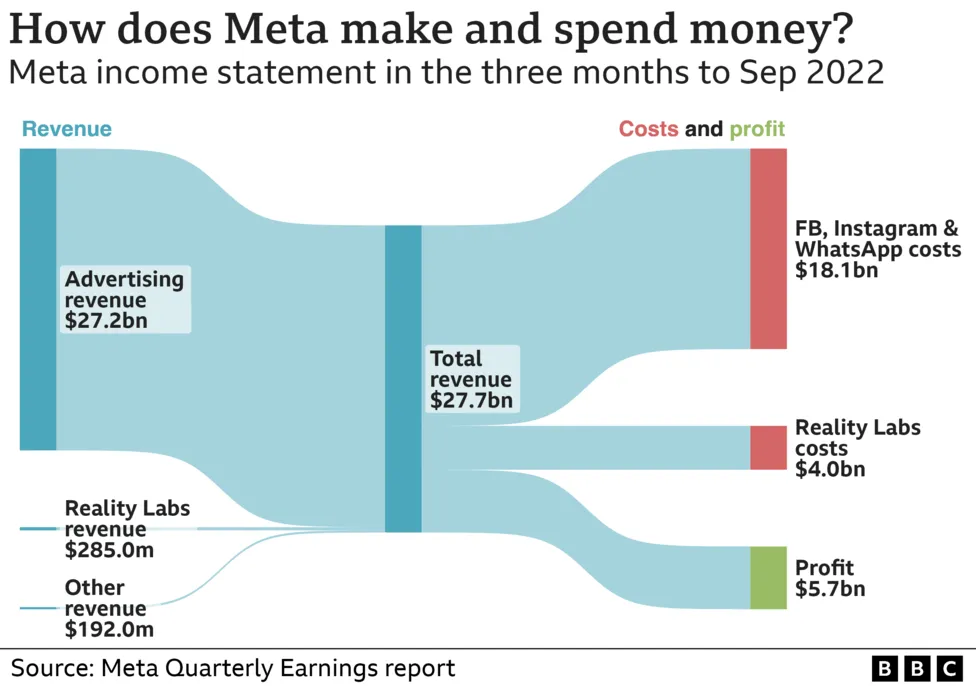
Compared to any normal company I'm sure it was a fantastic Q1. Tech is just addicted to 25%+ profit margins and the market apparently considers it a failure when they "underachieve", which is objectively ridiculous.
Facebook offered me $1.2M base pay, $500k in options, and $220k in relocation -- for a Sr. Front End Dev position. I sit down. Mark himself walks in, looks me straight in the eye and says, "Honey, Honey". I'm like, "What the--"
That's when I woke up and my wife was telling me, "Honey, Honey, you're going to be late for work."


So I logged in and changed my password and deleted my account again. Facebook tells you that it will take 30 days to delete your account. This is obviously user hostile bullshit.
Meanwhile somehow the scammer is still posting weight loss stuff on my account. Feel like I've jumped through enough hoops so I'll just let that person pollute Facebook more. Their problem now.
And I won't call them Meta, what a joke. Everyone should quit, get ahead of the layoffs, useless company. Your work there makes the world a worse place. You can do better.