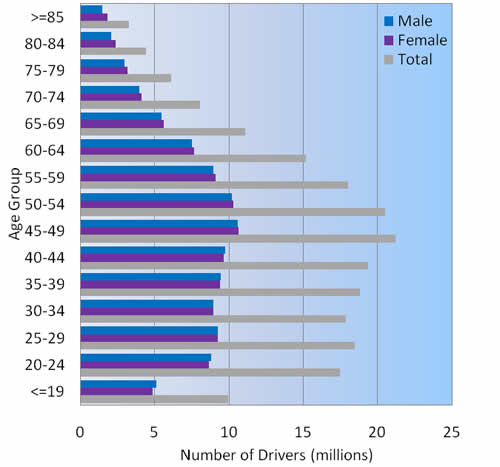
I think this is easy to wish but hard to realize, considering the US population is rapidly aging. There is a balance between prioritizing pedestrians and cyclists while still supporting reasonable mobility for those not in their prime as well as daily freight/parcel services.
That's why you can't have a city based on cars. The very old cannot drive! I don't know why this perfectly obvious and globally well-known fact is so little-known to Americans.
There are entire retirement communities where the elderly use their golf carts and cars to get around (Sun City, FL, The Villages, FL, etc).
Not only do the very old still drive, many prefer it because they’re old.
Go talk to some old folks. I did when I put together a community funded Tesla Model 3 rideshare for them in a retirement community. The pool is their preferred exercise method to walking, especially in inclement weather (you ever walk a mile in the July Florida/Texas/Arizona heat? I have in all three, and I would not recommend it).
EDIT: @jeffbee Responding here as HN has throttled my comment replies.
> That's contrary to all available data. People over 70 are the least-likely group of adults to have drivers' licenses and have the highest public transport mode share or any group, take the fewest trips, and travel the smallest distance per day. The elderly are arguably the people who stand to gain the most from compact patterns of development.
And yet, they choose to live in low to medium density areas that require an automobile versus urban areas. Behold the revealed preference!
That's contrary to all available data. People over 70 are the least-likely group of adults to have drivers' licenses and have the highest public transport mode share or any group, take the fewest trips, and travel the smallest distance per day. The elderly are arguably the people who stand to gain the most from compact patterns of development.
Let's get to the bottom of this then. Propose 3-5 questions that you think would provide sufficient insight into the senior housing preferences of this older/elderly cohort and I will get them to a contact at Pew Research to inquire and provide objective data back (unless you have citations you have not provided in thread).
This is ridiculous. Yes, of course, provide alternatives for the less able but that is a very small population at any age group. My grandmother at age 86 gets around in Germany on foot and by bicycle just fine. She doesn't have a car and has access to the subway for longer distances. We can still heavily pedestrianise while also allowing for deliveries and the less able, there are many successful examples.