This is a huge step in the right direction. Despite anyone's opinions on death and burial traditions, the reality is that the most common practices are not eco friendly.
In the U.S. each year we bury 20m ft of hardwood, 1.6m tons of concrete and 4.3m gallons of embalming fluid. [1]
An average cremation takes 28 gallons of fuel. [1]
Also, just my own opinion based on observation, why do cemeteries get all the best real estate?? Dead people can't enjoy that view.
Cemeteries get the best real estate because they can wait it out the longest. When a town is formed the cemeteries are usually in the outskirts. As the town grows these outskirts become the suburbs which then become part of the urban core.
An average American has a carbon footprint of about 20 tons per year, so the ~540 pounds emitted from cremation (stat from that article) is a drop in the bucket.
Not to be flip about carbon use, but this is people's final wishes we're talking about. Death is a big deal.
It also isn't strictly about the dead, but rather about the living who get peace of mind from knowing that their wishes will be respected upon their death.
Not to mention the mental wellbeing of their friends and family.
I think this comes from purely emotional perception of, well, life. And pure emotions are bad advisers more often than not. Rational view would be, no matter what religion (or lack thereof) - body after death is just a pile of fast decomposing organic material, nothing important neither for living nor deceased.
I have much more respect for some eastern religions like Zoroastrians or some Buddhists in Tibet/high Nepal who chop the bodies of their close ones and leave it to predators. That's a true expression of proper belief in their religions.
People can't stand sight of their close one decomposing (apart from some remote tribes who have mummies/skulls of ancestors around the house), some would even be properly traumatized, but yet there is some obscure need to have the same biological matter confined somewhere where they can come and feel 'connected' again. Wouldn't a photo/3D model/hologram of the person achieve the same?
I mean, I wouldn't care less if somebody brings some flowers to my grave or lights candles. Just remember me when convenient, some good experiences and I will be glad
That's not a whole lot. The fuel cost of everyone flying or driving out to the funeral probably dwarfs it.
Of course, we could make cremation more efficient if we didn't want to generate ashes for people to take home, but that's a pretty cheap cost for the emotional value.
I wonder if it's because embalming is a product you can sell someone with a large profit margin because the market price of body embalming is murky at best.
I did paid biz research on the funeral industry in 2010 on summer break from my mba for an Irish company looking to extend into the US focused on funeral for Irish people.
There was a huge amount of consolidation going on as mostly family funeral parlors were being bought up by a few scaled players.
There is a huge amount of money tied up in funerals. Looking at the generational switchover, with boomers presumedly wanting traditional burials, grave sites and granite headstones—-not yet at its peak.
I wonder if the funeral industry will tip around the same time some have suggested the housing market will.
Traditionally you'd get the body into the ground in three days max. Nowadays that's not happening unless (like some religions) you make it a point of principle. With bureaucracy and far-flung families it frequently takes weeks.
I have to admit that I don't "get" the concept of the viewing (in most cases, apart from identification of course). My grandma died a few years back and the body was available for viewings. Unlike most of my family I didn't go.
My last memory of grandma was us all together as a family at my aunt's house on Christmas day, her sitting there in an armchair beaming at how proud she was of her family and giving out hugs and kisses to her grandchildren and great-grandchildren. She died a few weeks afterwards of heart failure.
It's one of my fondest memories and I'm sure she'd rather be remembered that way than as a cold, lifeless body on a stainless steel slab.
> I have to admit that I don't "get" the concept of the viewing (in most cases, apart from identification of course). My grandma died a few years back and the body was available for viewings. Unlike most of my family I didn't go.
> My last memory of grandma was us all together as a family at my aunt's house on Christmas day, her sitting there in an armchair beaming at how proud she was of her family and giving out hugs and kisses to her grandchildren and great-grandchildren. She died a few weeks afterwards of heart failure.
> It's one of my fondest memories and I'm sure she'd rather be remembered that way than as a cold, lifeless body on a stainless steel slab.
For some, the memories are not enough, and to touch the skin of a loved one one last time (even if there is no warmth behind it) before their body if forever removed from the world, is a special moment.
24 hours seems a little fast. I’ve encountered bodies that have sat for 2-3 days unnoticed (estimated) inside of their house, in the summer, and it’s not too terrible of a smell. If anything, you’d start to see bloating and discoloration, but not enough decay will happen within 24hours that would result in a closed casket viewing. Also, once they stick ‘em in the freezer at the morgue, you’re stalling that decay tremendously — at least long enough to make it to the funeral, which is sometimes up to a week later.
Also, to talk about the parents point on prime real estate, i’m not sure what current rates in other states for a plot but where i’m at, you’re looking at >$1,500/plot for one casket.
> Also, just my own opinion based on observation, why do cemeteries get all the best real estate?? Dead people can't enjoy that view.
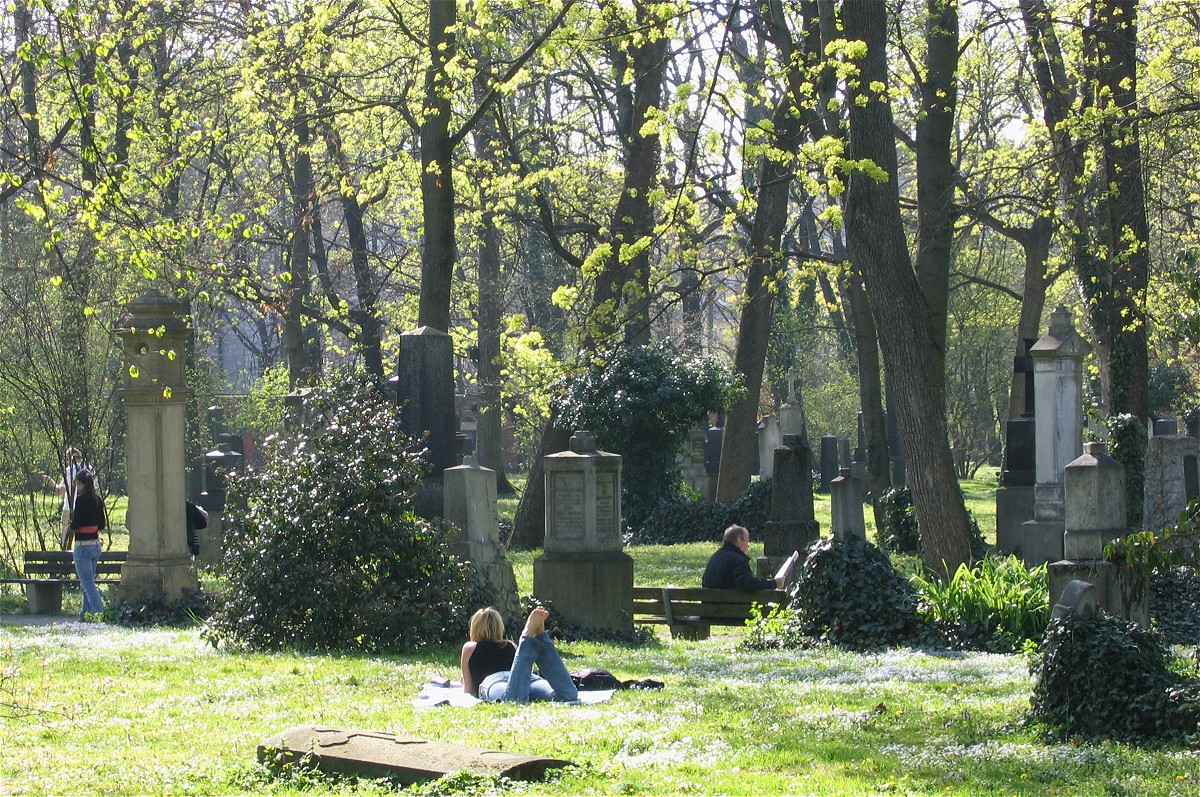
Old cemeteries are de facto parks in cities that grow up around them. They're quite nice and a decent use of land in areas that don't have the sort of pressing housing needs that SFBA has.
In Munich, I lived near the "Old Northern Cemetery", where the last person was buried in 1944, but I only recall seeing graves there that are far older than that. It is now officially considered a park, and people use it for jogging or just lying there to relax:
https://upload.wikimedia.org/wikipedia/commons/4/48/Alter_No...
It's quite a weird feeling, looking at those gravestones (sometimes quite beautiful and impressive, to be honest), and knowing that, for almost all of them, no one is alive anymore that could have actually known them.
Hmm, why? As I said, the cemetery has not been in use for a very long time now. Long enough that the corpses have probably rotten away completely, and nobody knows the people who laid there anymore. So I don't think anybody is going there for grieving.
The Wikipedia article itself mentions jogging as one of the uses, so I'm not making it up (at the same time it mentions "with due respect", and personally I also don't think jogging is "disrespectful"): https://en.wikipedia.org/wiki/Alter_Nordfriedhof_(Munich)#Pr...
Not everywhere, and real estate is precious. Near by we have a Chinese cemetery, complete with coloured neon lights, karaoke machines, outdoor fitness centre, and jogging track going through the tombstones. You don't want to get bored in the afterlife.
I agree I always figured if the circumstances of my death allowed for it I would just go on a hike deep into the mountains, lay against a rock and die. I am not a huge fan of cremation or the traditional casket approach.
As space costs lower, one extremely predictable industry/business will be 'casket pods.' You get ejected in space at escape velocity left to wander until entering the orbit of who knows what, along with a natural cryogenic preservation. Kind of interesting to imagine sci fi scenarios such as one of these pods being the exogenesis that drove the seeding of Earth (or Mars as it may have been).
As programmers, we often discount the human element in the social context. It turns out that funerals are a very widespread and in some people's opinions a very necessary part of life.
Unfortunately, many of these practices change awfully slowly and arguing with people over their rites and traditions is a pointless (and somewhat insensitive) exercise.
You'll find on the African continent that graveyards are ridiculously large and elaborate (esp. in Southern Africa). My only guess is that these things improve with better education and in turn, that whole process is inevitably slow.
I can't say much for the US, but certainly it has the resources to be more innovative.
When cemeteries where first created they were generally put on relatively unproductive hilly ground outside of the city or town. Not sure why you think they got all the best real estate?
Most cemeteries are open to the public so if they are in a city they are like parks and are very nice to have. I guess my comment is that the land a cemeteries takes up is not likely to be any more prime than any other land in a city.
Half of Colma seems to be graveyards, but I bet they could fill it to the brim with 4 story housing units and not put a dent on bay area demand... always boggled my mind.
It's more than half, actually (IIRC upwards of 70%). Colma was specifically incorporated as a necropolis, and the dead outnumber the living by something like 1000-to-1.
Sure, maybe a bunch of cemetaries ain't the most efficient use of space, but it's certainly a really cool use of space. I live in close proximity to it, and appreciate it as part of the not-quite-green-belt between Daly City and South San Francisco.
At the end of this March I was in Stockholm. One of the most unusual "highlights" (I consciously choose to visit this place for its nature) of the trip was the breathtaking woodland cemetery called Skogskyrkogården[1], located just outside the city.
I spent 3 hours of walking and reading there. It's one of the most beautiful and serene nature places I've ever been to. When you enter, there are no graves in sight — a sign that nature is the central focus, not the graves. These are mainly located in the depths of the woodland.
It's a UNESCO World Heritage site; this was their justification[2]:
Outstanding Universal Value:
Skogskyrkogården, located south of central Stockholm, Sweden, is an outstanding early 20th century cemetery. Its design blends vegetation and architectural elements, taking advantage of irregularities in the site to create a landscape that is finely adapted to its function. [...] Asplund and Lewerentz’s cemetery design evokes a more primitive imagery. The intervention of footpaths, meandering freely through the woodland, is minimal. Graves are laid out without excessive alignment or regimentation within the forest. Asplund and Lewerentz’s sources were not “high” architecture or landscape design but rather ancient and medieval Nordic burial archetypes.
Skogskyrkogården is an outstanding example of the successful application of the 20th-century concept of architecture wholly integrated into its environment: the chapels and other buildings there would lose much of their meaning if isolated from the landscape for which they were conceived. The Woodland Chapel is intimately integrated into its setting, whilst the impact of the later group of chapels is heightened by the use of their landscape as a background. In both cases, the architecture has a quality of austerity that is appropriate to its function and does not compete with the landscape. The success with which Asplund and Lewerentz integrated natural with artistic and architectural values gives this cemetery an outstanding independent cultural value. Considered to be of the highest artistic quality, Skogskyrkogården has had a profound influence on cemetery design in many countries of the world.
My family's been in the cemetery industry for about 60 years, and your last observation is rather interesting from my perspective. You're absolutely right that cemeteries aren't for the dead. They're for the living, some people do take a degree of comfort--maybe even satisfaction--in knowing where they'll be buried. I've actually seen people bring a blanket out and sit for hours at their future gravesite, odd though that may have seemed to my younger self.
In my anecdotal experience, most modern/currently operating cemeteries aren't really situated in the best real estate. But most landscaping maintenance and beautification practices do tend to make them appear more inviting/relaxing/beautiful than just the land itself would seem to be on its own. In that sense, they're not all that different from parks; the name "memorial park" (cemeteries with bronze or sometimes stone markers flush to the ground) and the ideas behind the philosophy pretty explicitly evoke that image.
Older, historical cemeteries are a different matter altogether. As another commenter pointed out, some of them were originally located outside the urban core but still close enough for relatively easy access to transportation. Church cemeteries were often located immediately outside the church. Some were never really envisioned to amount to anything, but expanded slowly over time. The same passage of time turned their locations into valuable, prime real estate. And the same landscaping and greenery that most cemeteries try to cultivate, along with the sheer weight of history on their grounds, can turn them into wonderful places for the community to visit. Many of the monuments and private mausoleums are stunning pieces of architecture and workmanship, and the dark Quincy granite that you'll often find is instantly recognizable. Even more so than their natural beauty, these places tell a part of our history, good and bad. Not every cemetery was preserved like that, of course; others are forgotten entirely and re-discovered during construction projects. Or they can be damaged by natural disasters, such as when a thousand caskets floated away after Hurricane Katrina and had to be tracked down and reinterred.
Sometimes, that land is too appealing or valuable, which can lead to cemeteries being moved to another location in their entirely. It's such a royal pain in the ass, though, it's very rare nowadays unless there's no alternative such as with major infrastructure projects and the like, with many states having laws that protect cemeteries from arbitrary eminent domain and redevelopment, and requiring court orders for each individual grave, efforts to track down next of kin, etc. My grandfather's company was hired to help move a cemetery for a University of Pittsburgh stadium back in the late 50s or early 60s, if I recall correctly. Years earlier, it was much more common to move cemeteries and reinter the remains as cities grew. Sometimes happening more than once, which can give genealogists fits at times.
As for the environmental impact, you can look into alkaline hydrolysis as a cremation alternative, at least in the 14 states it's currently legal in.[0] It's much more environmentally friendly (no mercury pollution, for example), save for the wastewater it produces (around 300 gallons per body).


In the U.S. each year we bury 20m ft of hardwood, 1.6m tons of concrete and 4.3m gallons of embalming fluid. [1]
An average cremation takes 28 gallons of fuel. [1]
Also, just my own opinion based on observation, why do cemeteries get all the best real estate?? Dead people can't enjoy that view.
[1] https://www.huffpost.com/entry/how-your-death-affects-cl_b_6....