Wage growth would help, but for some reason, these articles never even mention immigration. The scale of immigration both legal and illegal I believe has the greatest impact on the lowest sectors of society. The lack of discussion on the impact so many potential new workers is having on wage growth leads one to think they believe labor cost is the one thing immune to the law of supply and demand.
The FT had a couple of great podcasts last year ([0], [1]) that discussed the economic and fiscal impacts of immigration. I don't remember all of the details, but the key points were, to the best of my recollection:
* Highly skilled/educated immigrants provide a significant boost to economic growth and pay more in taxes than they receive in benefits. I don't recall whether the podcast addressed the impact of these immigrants on the wages of highly skilled native-born workers.
* Low-skill immigrants are a net positive in the long term (i.e., once their children grow up) to the economy as a whole, but their net impacts in the short term are somewhat ambiguous, and there is some evidence that they bring about wage decreases for low-skill native-born workers. While that evidence is not completely clear-cut, it seems likely that there's at least some level of impact. There's also evidence suggesting that some of the displaced native-born workers "climb the ladder" into higher-skill, higher-wage positions when this happens, which may mitigate that impact.
From what I've read more generally, my impression is that outsourcing has a much larger impact on unskilled workers' wages than immigration does, though I don't have a specific source to support that claim.
Imagine an extremely simplified model where all immigrants to a city are experienced taxi drivers. There's more demand for goods, but probably only a small uptick in demand for taxis. The supply of available taxi drivers has gone way up however.
Do they? By how much? Immigrants have usually low wages. Anyways, in Western Europe, the increased demand (which is probably smaller than in the US), those things are easily canceled by the added costs to public healthcare + social benefits.
In belgium the rising healthcare cost is almost entirely due to an aging population. To take care of those elderly you need nurses and care workers, 46000 extra per year for the coming decade. Meanwhile the schools only graduate 5000 per year, due to lack of interest by the native population because of the odd hours in nursing. The only way they’ve found to bridge the gap and take care of the elderly is bringing over people from the phillipines, because it turns out this problem exists across europe (aging population = care gap). Those immigrants are not taking anyone’s job away, they earn a decent wage and they’re doing a net positive contribution through work, taxes and commerce.
That’s an anecdote but there are plenty more like that. All of which is to say that the story the right pushes about immigrants being bad for the economy is just a story and doesn’t necessarily fit the facts.
There is "lack of interest by the native population" only because wages have been pushed down by people from the Philippines. Even with odd hours, people will gladly do the job if the pay is good.
The elderly, with failing ears and minds, have enough trouble understanding the speech of the native population. Subjecting your elderly to nurses that can't be understood at all is elder abuse.
> Even with odd hours, people will gladly do the job if the pay is good.
Definitly true. However good pay costs a lot of money, so less care workers can be hired with the current budget. Either you have to spend more money or accept a reduction in the level of care.
Hasn't the aging population paid their fair share though? How does it help to bring in more adults who for the most part have low wage jobs (=little or no taxes to collect), and will most likely live close or the same number of years as the original population?
You could argue that by bringing Filipinos in you lower the wages, and as a result, the native population is less interested in taking such jobs, besides lowering the "status" of the job itself.
I was recently looking for a nanny in Spain and most applicants were Spanish females. Despite that, most parents seem to hire foreign nannies from LA because it's cheaper.
That said, it's really sad if the elderly in Belgium are being taken care of by people they barely can understand. What a nice ending of life!
I remember from my time in the Netherlands that the elderly there get regular visits from a specific person whose job is to socialize with them to solve some of the "loneliness" problems. I wouldn't be surprised if something similar happens in Belgium, which is IMO, a growingly anti-social society.
In Spain (which has the highest life expectancy in Europe by the way) many old people are still taken care of by close family members, or in other cases by people from LA who at least speak the same language. I didn't realize how fortunate they actually are.
If immigrants are young working adults, then you are, in fact, getting an educated (At least high school, often post-secondary) adults, for whose education, food, shelter, and childcare you didn't have to pay a penny for.
Turning them away is like turning away a gift of hundreds of thousands of dollars.
> Anyways, in Western Europe, the increased demand (which is probably smaller than in the US), those things are easily canceled by the added costs to public healthcare + social benefits.
No it doesn't. This narrative is nonsense. There's a lot of research on the impact of immigration on, for example, Germany. None have concluded that such immigrants are doing anything but supplying desperately needed labor to Germany's economy and have had significant positive benefits [1].
The fact that it is so easy to learn about this (there's plenty of data, much of it free and easily available) and yet people continue to spout this narrative speaks volumes.
I'd argue that legal immigration has the greatest impact on higher sectors of society- such as salaries in software / IT. This can be fixed by raising the minimum pay for H1Bs. I'd believe that illegal immigration has a incredibly small effect overall.
The illegals are all picking strawberries for below minimum wage so we don't have the bear the true costs of our food. Remove them and there would be serious repercussions for those at the lower strata of society.
An anecdotal observation. In the majority black city where I live 50% of black men are unemployed but if you look at the numerous construction sites workers are largely Hispanic.
I worked at a hotel for several years in the early 2000's the housekeeping staff was overwhelmingly black women and men but shifted dramatically to Hispanic women and men after new penny pinching ownership took over and started using some dubious temp agency.
I don't begrudge the immigrants, I'm second gen on one side and wanting a better life is completely reasonable. I do however think it's completely disgraceful that we turn a blind eye to employers that break the law because they don't want to pay a living wage, or want compliant semi-disposable workers.
> I worked at a hotel for several years in the early 2000's the housekeeping staff was overwhelmingly black women and men but shifted dramatically to Hispanic women and men
The Hispanic staff that doesn't seem to have anything close to living wage is a pervasive feature in the Bay Area too. I'm not sure if, and to what extent, they displaced black workers in the Bay Area though.
The slaves are all picking cotton for below minimum wage so we don't have the bear the true costs of our clothing. Remove them and there would be serious repercussions for those at the lower strata of society.
As you've mentioned the real cost of food and farming in the US is effectively heavily subsidized by the fact that many of said farms employ illegal immigrants for labor, both because they refuse to pay minimum wage and because Americans as a whole seem to refuse to do said jobs.
Legal immigration has a comparatively small effect due to the fact that they're part of the skilled labor force and generally fill gaps in our society. The number of people actually holding H1Bs is so small that I find it hard to believe they have any major pull on the various sectors outside of the few firms that are known to be abusing the system.
Fixing the system in a humane way that also doesn't blow up the lower classes is a herculean task.
If we raised farm labor wages by 40% it would cost the consumer less than $25 a year.
”For a typical household, a 40 percent increase in farm labor costs translates into a four percent increase in retail prices (0.30 farm share of retail prices x 0.33 farm labor share of farm revenue = 10 percent, farm labor costs rise 40 percent, and 0.4 x 10 = 3.6 percent). If farm wages rose 40 percent, and the increase were passed on fully to consumers, average spending on fresh fruits and vegetables would rise by about $21 a year (4 percent x $530 = $21).
Giving seasonal farm workers a 40 percent wage increase, on the other hand, would raise their average earnings from $11,720 for 1,000 hours of work to $16,400, lifting the average worker above the federal poverty line of $11,770 for an individual in 2015.”
Has anyone ever calculated the maximum possible wage for a job? Take strawberry picking for an example. If run by a non-profit, what is the highest possible wage? Would be interesting to see this relative to the actual wage.
The entire farming industry is distorted. It's much more subsidized and controlled than most industries. For instance we literally pay some farmers not to grow food. And at times when harvests are high the government will prevent farmers from marketing some portion of their harvest which, in extreme cases, can mean that food simply ends up getting destroyed. It's all about extreme manipulation of supply to try to control prices.
I'm not really supporting or opposing the system, which is a topic for another place, but just mentioning that farming is not like people think it is. So trying to determine what 'market wages' would be like is not really possible when much of the entire industry is operated outside the bounds of the market.
> For instance we literally pay some farmers not to grow food. And at times when harvests are high the government will prevent farmers from marketing some portion of their harvest which, in extreme cases, can mean that food simply ends up getting destroyed
Wait, so they are intentionally keeping food prices higher by paying people to not grow food? I mean, I understand that we need farmers and dipping food price markets isn't ideal, but... wow... what a world.
It's most likely from the Grand Depression, when farmers were literally throwing away food because of over production. Subsidies smooth out production cycles and keep farmers in business.
I think it would fluctuate depending on the prices of strawberries. And if you spent all your money giving out the maximum possible wage and your crops failed you’d go out of business because you weren’t able to save money.
Exactly. This cannot work without forcing a whole range of products a LOT more expensive than they are.
That's a feature, not a bug.
But yes, the rest of society will become a LOT "poorer" (but still comfortable) for no more than a decent increase in the living standard of the working poor.
So you’re saying those illegals are basically slaves? Wouldn’t the ethical thing to prevent illegal immigration into the country knowing that these people may be abused?
This does not seem obvious to me. For example, imagine if you overnight doubled the US population. Would wages go down? Well, overnight you would also double the economy and double demand for just about every kind of work, from hairdressers to security guards. What's the overall effect? (And you are talking about just 3.5%, not 100%.)
Quoting from the abstract: "…This paper describes
the effect of the Mariel Boatlift of 1980 on the Miami labor market. The Mariel immigrants increased the Miami labor force by 7%, and the percentage increase in labor supply to less-skilled occupations and industries was even greater because most of the immigrants were relatively unskilled. Nevertheless, the Mariel influx appears to have had virtually no effect on the wages or unemployment rates of less-skilled workers…"
We can actually hold for immigration to some degree. For example, while not exactly doubling, the entry of women into the workforce after WWII had a similar effect of massively increasing the the supply of labour.
You would think that two income earners in a household would increase the economy enough that wages would need to rise due to a subsequent shortage of labor... but it did not.
Wages, in real terms, have largely lost purchasing power to the point where it takes two incomes to have the same (or less) purchasing power than one income did prior to WWII.
Part of it is the productivity gains made post WWII (i.e. we can do more with less labor) but a lot of it is the supply side of labor and competitive pressures pushing the price equilibrium (wages) down.
I'm not making an argument against the entry of women into the workforce. I'm an advocate for 'freedom' so I'm all for women doing what they want as long as they are following the law. My point here is the supply side of labor does not have a large enough increase to the demand side of labor to make up for the decrease in the price of wages.
> Wages, in real terms, have largely lost purchasing power to the point where it takes two incomes to have the same (or less) purchasing power than one income did prior to WWII.
There are also longitudinal effects at play: native-born Americans have seen their wages rise but this is offset by immigrants who generally have lower-than-average wages (but still higher than in the country they emigrated from). Both groups are better off even though average wages haven't changed.
I had a quick cursory glance for useful contrasting data to show how while wages in real terms have stayed flat in the US, things like college tuition fees[1] and house prices[2] have not.
Both of these things are pretty important - college education can be life altering in terms of career trajectory, and owning a house is an entry point into the wealth ladder and also simply an escape from rent. In real terms, the cost of these has runaway over the past 20-30 years and so people's access to two crucial things that aid social mobility (wealth/housing and education) have been eroding over the years. But apparently because our money can still buy a basket of goods we should be satisfied that our lives haven't gotten any worse.
For me, and I'm pretty sure it's quite complex and I am guilty of Dunning Kruger wrt politics and economics, I simply cannot understand how inflation can get away without finding a way of placing these in the basket of goods used to calculate inflation.
One difference between adding women to the workforce and adding immigrants is that women were already customers of the economy. Women working increased the pool of workers but not the pool of customers. Immigrants would add to both.
Yeah my point was that, at the margin, the increase in labor would have more of a downward impact on the price equilibrium of wages than it would (eventually) have in an upward way.
The argument I am arguing against is something like:
Immigrants join the labor force -> They increase the economy -> The increase in the economy increases jobs -> More jobs increase wages.
I think this what you are essentially saying?
The problem here is inflation and productivity. In order for everyone to prosper either:
1. There is no inflation and therefore purchasing power is maintained, or
2. Wage growth and interest rates outpace inflation.
No. 1 will not happen under our current monetary system, and no. 2 has not happened due to:
a) Competition in the labor market has keep real wage growth flat, and
b) The unprecedented (in the history of mankind) money creation (AKA Quantitative Easing) used to bail out financial institutions has destroyed interest rates and created a massive inflation in asset prices.
Another factor is that different jobs impact the economy differently. Or put another way, different jobs create different levels of 'value' in society (the monetary kind not moral kind). The difference between the price of a good or service, and the perceived value of a good or service is the 'consumer surplus'.
Fact is, highly skilled immigration is going to create a higher level of consumer surplus compared to low skilled immigration. Highly skilled immigration in areas where there are shortages is going to also have a bigger impact on economic growth.
I think you will be hard pressed to find anyone arguing against this sort of immigration... the issue that dare not be spoken is the impact low skilled and illegal immigration has on the labor market.
And most of it is greedy corporations and lack of worker protections. There's always enough money to increase CEO salaries.
I can concede that unskilled immigration is putting downward pressure on the salaries of low/no skill workers, but the US social inequality is the elephant in the room.
The effect of a doubling of the population depends entirely on who the new people were. Are they native speaking engineers, doctors and pop stars? Or illiterate and sickly old people?
One thing is for sure, housing prices would skyrocket!
> One thing is for sure, housing prices would skyrocket!
Sure, in the hypothetical of instantaneously doubling the population without any time for the market to adjust for increased demand. But if the population doubles over the course of 30 years? That's only about 11 million people a year, the market would expect and adjust to the influx of people easily. Governments would also ideally be devising initiatives and changing policy to promote affordable housing. The high cost of housing in the US is its own issue anyway.
Most immigrants (legal and illegal) are not Indian software engineers working at Google. They are low skill/poorly educated and got in on refuge status or because they have a family member already in the country. They work as taxi drivers, construction workers, cashiers, etc. It's not a huge leap of imagination that a constantly increasing low skill labor supply is to the detriment of current workers in these fields (many of whom might be immigrants themselves). 29% of immigrants lack a high school degree or equivalent GED and are disproportionally represented in the service industry, construction, maintenance, and other blue collar positions.
So yes, it is likely that immigration rates have a negative effect on the wages of native workers in low barrier of entry positions. You'd have to suspend disbelief to accept the narrative that there is no impact.
It’s more complicated than that though. In Denmark where I live, we have trouble staffing certain industry jobs. Jobs like gutting, freezing and packing fish or general slaughter houses.
It used to be that these were low paying jobs, packed with immigrants. Since you need a social security number to work, and we’re rather good at finding people who cheat the system, illegal immigration workers isn’t really a thing in factories. But the system and legalization was still exploited so paying immigrants less was possible.
Anyway eventually regulation caught up and ended the low pay loopholes. So now a job at those factories pays half a million kroner a year, or more than I earn as a senior IT-architect.
As a result a lot of our slaughtering houses moved production and enrichment out of the country, but the really interesting thing is the fishing factories. They couldn’t move or outsource production because they need to be located close to where the fish are caught.
Despite the pay hike they still can’t hire enough people without relying on immigration. It turned out that nobody wanted those jobs, even when they pay really well.
Ps. Im not sure what fishing factories and slaughtering houses are called in English but I hope you get the point.
> Anyway eventually regulation caught up and ended the low pay loopholes. So now a job at those factories pays half a million kroner a year, or more than I earn as a senior IT-architect.
I think this is an important point that many people seem to gloss over when discussing what humans _deserve_ to be paid.
Many believe the uniqueness of a skill set or how much physical stress is inherent to a position should be the only factors which increase a salary.
But the point you highlight here says that the amount of soul-crushing misery a position entails should also play a significant role when determining salaries.
It seems that in many countries, companies can get away with paying soul-crushing positions so terribly because so many people are coerced into these jobs--forced to choose between incredibly soul-crushing, low paying positions or watch their families starve, become homeless, not be able to afford medical care etc...
Which leads me to wonder if there are any societal changes we could make in order to nudge salaries to reflect when a job is mentally abusive. Similar to how pay typically reflects when a job is physically abusive.
I'm guessing Denmark has a decent safety net which forces companies to actually factor in mental abuse of a position when they're formulating salaries which ensures their citizens are compensated accordingly?
> Which leads me to wonder if there are any societal changes we could make in order to nudge salaries to reflect when a job is mentally abusive. Similar to how pay typically reflects when a job is physically abusive.
A basic income would work here. If people aren't forced to take a job out of economic necessity then unpleasant jobs will need to pay more to attract people to do them.
I have to disagree here. If a job causes soul crushing misery, it just shouldn't be allowed, period. If the people of Denmark can't stomach slaughtering animals for a living without being coerced into it then the people of Denmark should be vegetarians. Meat and fish should simply stop being sold or produced.
This also shows why high import taxes are a necessity. Not an option for Denmark (because they've signed away that authority to Brussels), but a necessity nonetheless.
To prevent factories from avoiding low worker wages by producing in an area where those abusive salaries are allowed by the government, or even are the pervasive wages.
I would have no problem with producing locally where it makes sense, but not to avoid minimum legal standards for wages (or for that matter for other things like environment).
Your story is very confusing. If (legal) immigrant workers were willing to work for a lower pay (because of the low-pay loopholes) why wouldn't they be willing to work now for a higher pay?
As I read it, companies were using "loopholes" (think H-1B visa-alikes or even shadier stuff) to bring immigrants in. As the gov shut down these loopholes, the situation evolved to nobody willing to work there.
The story isn’t about immigrants, they are still willing to work the jobs, as you point out. Instead it’s an example of how the narrative of “if immigrants didn’t cause low wages then Danes would work the jobs” isn’t always true.
It’s not just that it’s hard labour either, it’s also that handling fish is extremely low prestige.
So the story is more about the nuances and complicated nature of the job market. It’s easy to blame immigration, and it’s not like immigration doesn’t have an impact, it’s just that there are a lot more forces at play.
Nothing with so dense a web of causes and effects can be obvious. Might fewer low skilled workers driving the wages higher for those remaining also drive up the costs of the goods and services they produce? Would their new higher wages offset those higher prices or might they be worse off than before?
The suppression of dialogue surrounding immigration far exceeds downvotes in scope and severity.
In fact, the suggestion that tosser00001's main point had anything to do with silly internet points is a minimization/redirection tactic that is itself a more important instance of the very thing being complained about.
> The problem with the anti-immigrant zealots is they never provide any evidence for their paranoid fantasies about immigrants increasing unemployment or supressing wages.
Ironically, your post also contains zero evidence for your claims.
> concluded it has insignificant impact or improves the economy
Just because it improves the economy doesn't mean it's improved the lives of all people in it. With the detachment of wage growth from economic growth in recent decades you can probably expect people to stop caring about what's good for the economy altogether pretty soon, economic growth is just an abstract number disassociated from the reality of most.
> And you think immigrants are responsible for this?
Yeah, it was immigrants who engineered the massive Reagan-era tax burden shift off of elites and on to the working class (and subsequent downward tax burden shifts under Bush 43 and Trump which reinforced the effects of the Reagan shifts.)
> And you think immigrants are responsible for this?
Entirely? No. Partially? Yes.
Most notably immigration has a huge impact on housing and the ever increasing demand for it. This alone is responsible for much of the fall in living standards.
> Do you have any evidence at all for this claim or is this just something you made up out of thin air?
I need a citation for "more people == more housing demand"?
I really don't care what academics say about the cause because they're divorced from reality. The reality is that as a single, well payed software developer with no kids I'm now on the downward slope of paying off the mortgage of my small studio apartment. My father at the same age had 2 kids, a stay at home wife and was on the downward slope of paying off their 4 bedroom house with a huge yard and a pool, all on a minimum wage job.
Yet economists keep telling us how much richer this generation is.
> I need a citation for "more people == more housing demand"?
"More people => more housing demand", ceteris paribus, is trivial. And ceteris is probably sufficiently paribus that it follows even in reality. But your claim wasn't "more housing demand" but "a huge impact", and we've established nothing about sizes.
> I really don't care what academics say about the cause because they're divorced from reality...
I feel like this is unfair... We should be here for good faith discussions--not to set up arbitrary goalposts which it would seem are impossible to reach.
The overwhelming majority of people who still claim in 2018 that "anti-immigrant zealots never provide any evidence" are either knowingly lying (disengaging and pretending not to remember when they do encounter an intelligent objector) or have Bayesian priors amounting to religious zealotry which make it impossible for them to recognize evidence for what it is.
"Private business was just one of several examples I gave to illustrate principles which hold across a wide range of scales of human organization.
It is straightforward to verify that they don't stop holding at nation-scale. A good place to start is Lee Kuan Yew, who's both one of the only leaders in history to preside over the entire transition from Third World to First World for millions of people, and an architect of what's currently the most open immigration policy among Chinese-majority states. Singapore is a multicultural place whose government is widely acknowledged to have one of the best technocratic track records in the world, and they spent considerable effort on trying to get immigration policy right, iterating through alternatives while deliberately taking a popularity hit; what were their conclusions?
Or what are the odds, under your stated worldview, that two of the closest things to actual open borders existing in 2018 are (i) the Norwegian archipelago of Svalbard, which lets almost anyone stay as long as they can support themselves ...but ranges from 74 to 81 degrees N latitude, and (ii) the United Arab Emirates, which has more than five times as many expats as actual citizens, the largest number from India ...but ruthlessly maintains a two-tiered society, where even people who were born in the UAE and have lived there their entire lives are exceedingly unlikely to be granted citizenship unless they are Arab?
Contrary to claims that nothing like open borders has ever been tried, the existence of cases like this make it abundantly clear that this area of policy space has already been subject to substantial exploration. And every surviving result has an obvious and unusual force that does something similar to what traditional immigration controls accomplish in most countries, such as Svalbard's -40C winters. This is, to put it mildly, not a likely result if traditional immigration controls no longer have a useful function."
It may not be the final word on this subject. But it certainly points out several relevant, usually-neglected pieces of evidence. What did I get from my conversation partner as a reward? A downvote and no further response, of course; they weren't actually interested in truth or dialogue. The more I see this, the more strongly I advise everyone else to prepare to do whatever is necessary for self-defense against these people.
Mention it anyways, that is don't ever hesitate to post your opinion. Those who can't tolerate the topic aren't worth your argument/time but a lot of people wouldn't mind. Including me, an immigrant myself (not to the US though).
Didn't y'all just give the political party with neo-Nazi roots 63 seats in the Riksdag a few days ago? The labeling might be because at least some of the people talking a lot about immigrants are racists.
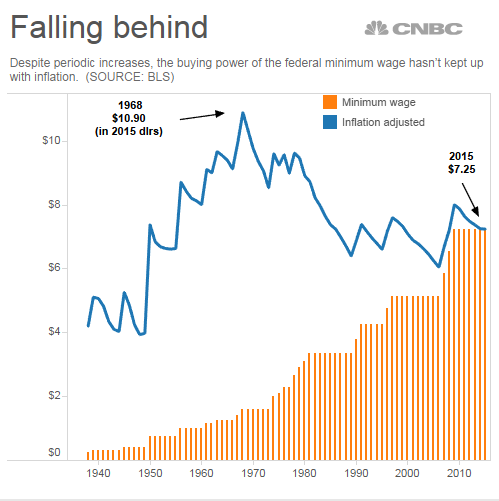
Have you checked minimum wage vs inflation chart? Seems that not having a minimum wage that goes up yearly to catch up to inflation has the biggest impact in wage growth. There are bigger fish to fry rather than speculate on the impact of immigration (but not as easy to sell to angry constituents), the current population is at ~320 million and you receive ~1 million immigrants a year, I'll give you the benefit of the doubt and let's more than double it and say 5 million. That represents 1.5% unwanted growth via immigration, I have my doubts that a change so small can have an impact so big on an economic system.
I think that this is a sleight-of-hand trick that comes up a lot in immigration discussion: he was talking about the small subset of the population that is most directly affected by the change, you switched the focus of the impact to the entire economic system. If you only look at the bottom 10% of society where the job competition is occurring, your 1.5% becomes 15% - annually! It's staggering.
Immigration applies downward pressure on lower/middle-lower labor classes and harms the power of unions.
I don't blame the immigrants who want to go where the jobs pay more - it's the smart thing for them to do - the blame here lies 100% on the corporations who exploit this (Tyson foods, etc.) and the politicians they ~~bribe~~contribute funds to.
The main point was inflation and wages. He mentions that "The scale of immigration both legal and illegal I believe has the greatest impact on the lowest sectors of society.", I doubt the impact is greater than the stagnation of wages against inflation where $2 min wage in 1968 is equivalent to almost $11 of today's dollars [0]. Current min wage is at $7.25. Do the immigrants vote for maintaining the minimum wage at the current level or where am I getting lost? I'm quite sure econ 101 says that if the salary goes up there will be more people willing to accept the job. Until that happens, of course a low-skilled immigrant will take that $7.25 hour job that no one wants. He will barely survive (while making sacrifices in the quality of life) and yes the corporation will happily accept it since nobody wants to do that work for that wage and people want low prices.
You say that as if those products are interchangeable. You cannot simply take those missiles away and buy 2000 water bags.
The US military, especially, is the largest job and training program anywhere in the world, including the military industrial complex (most of those military contracts, incidentally, do not just come with jobs, but with demands that those companies hire x0000 (3 or 4 zeros) in the states that have the highest poverty levels).
I'm not saying it's an ideal occupation (although, hey, Keynes seemed to like it when he was less on guard). So yes, I'd also much prefer them to be building better infrastructure. Or perhaps have a much cheaper postal service.
> That's where you money is going to, not $6 an hour fruit pickers spending all their money in food.
Perhaps. But the inability of the working poor to pick fruit at $15 an hour IS due to (mostly illegal) fruit pickers.
It is true that the defense and aerospace sector employs larges amount of people and drives significant amount of R&D. But getting inefficient for them became highly profitable and the F-35 JSF is the prime example of that.
Then, if fruit pickers made $20 an hour, you would be getting all of your fruit from Mexico/Central America, and fruit and all products made from it would be more expensive.
Other jobs like gardening and landscaping would simply either not be done, or get done by property owners themselves. Now they will be tired, be less productive at work and have less time for their kids, or, see their property value drop while their local crime rate goes up.
Not just that, those programs create (and are explicitly required to do so) large amounts of spinoffs in specific states. This is one force (almost the only one, frankly) that spreads knowledge, creates new centers of expertise across the US and thus binds the US together economically and socially. (NASA being the other, much smaller one doing this)
It would be very bad to kill it without replacement.
Pew Reasearch puts the number at 3.5%, which I think is quite high enough to impact growth. But downward wage pressure at the lowest sectors comes from both legal and illegal immigration.
It would be interesting to see what at short term lowering of immigration would have on wage growth.
Aren't a lot of these immigrants doing highly skilled and highly paid labor? They don't depress wage growth for low paying jobs. And they actually increase demand for their products.
You're conflating two groups. There are legal immigrants who stay, generally under the sponsorship of a company, and there are illegal immigrants who either come by illegally crossing the border, or by overstaying a legally obtained visa. Legal immigrants do tend to be highly skilled and relatively highly paid, though their wages are often lower than citizen workers in the same field - which can depress wages overall. Illegal immigrants by contrast tend to be involved in low skill and low pay labor, often done under the table.
Personally, I have nothing at all against the illegal sort. Day laborers, for instance, tend to be great workers and good people, happy to put in a hard day's work for a $50 and some good meals. At the same time though, I have to consider that this is really distorting the economy since it drags down wages for all people willing to do this work to that level, which is not really fair to people that want to make a living doing this work but want a higher standard of living, to raise a family, etc.
Not illegals. You realize that as an illegal you cannot legally work in the states right? You have no documentation, so anywhere paying decent wages would never hire you, because it's illegal and would open them up to fines and other legal issues. The only places that are going to hire you are going to do it under the table, pay you extremely low wages, and basically take advantage of you because you have no power.
No, I mean when it comes to the lowest of the low jobs, like hotel maid in terribly run bad hotel or garbage man, illegal immigrants represent almost a majority.
I don't have exact figures so I'm using 50% like "about half". I suspect though that it's only about half because some of them managed to legalize themselves, and in reality in these very bad jobs there's actually even more than that.
"Wages in rich countries are determined more by immigration control than anything else, including any minimum wage legislation. How is the immigration maximum determined? Not by the ‘free’ labour market, which, if left alone, will end up replacing 80–90 per cent of native workers with cheaper, and often more productive, immigrants. Immigration is largely settled by politics. So, if you have any residual doubt about the massive role that the government plays in the economy’s free market, then pause to reflect that all our wages are, at root, politically determined.”
Chang, Ha-Joon. 2011. 23 Things they Don’t Tell you about Capitalism, Thing 1: There is no such thing as a free market
The scale of immigration has definitely been whole lot higher in 1960s, not to mention 1920s of course when it was free and open for everyone who could pass a basic medical check.