My gripe is how iOS allows these companies to constantly bug us to use their stupid apps. I ended up installing the NYTimes app, not because I use it, but just to shut it up. I switched to duck duck go because I was sick of being bugged to install chrome. How many times do I need to say no?
I used to have a pro-cursor subscription, but it was way too expensive because I'd always hit my limit. I realized I could just use claude code + the free version of cursor for autocomplete and it worked even better. At this point, I'm not understanding the value that cursor is bringing. A souped up claude code? All I have to do is wait a few months and anything useful will be in claude code or codex or whatever.
So unfortunately this is it for me too. I liked Cursor as a tool, but when i switched to Claude I realized i was getting WAY better value for money. I spent $1800 the month before, i spent $200 the next.
I'm now switching between Claude and Codex for less than 1/4 of what I was spending in December.
Yeah, I tried using their Composer model (which I guess is Kimi) and it just feels sub-Sonnet to me. Whereas a Claude Max sub gets me more Opus than I can use in a month.
Which sucks because Cursor is clearly better than Anthropic at building UIs. CC desktop is buggy af.
Codex is nearly Opus level though. Anyone know if OpenAI permits Max subs to be used in Cursor?
I’d guess that there is less of a need for light at the beginning of the day since most people don’t farm. Personally I prefer more light at the end of the day.
I don't get that argument. The numeric time is just a measure for the state of the sun in the sky. When you choose your day to have ended is completely independent. There is already a high enough variance of people deciding when they go to sleep, that DST is hardly relevant. Some people have dinner at half past 5, some do at half past 8, the hour daylight saving time can't possibly make that difference.
It's not just a measure for the state of sun in the sky, it's also a measure for the state of society on the ground. It's an arbitrary number in a sense, but it also strongly influences my schedule.
And yes, we could have all the schools and everything else open later in the winter than the rest of the year, but it turns out it's easier to change the clocks.
But the school schedule does already shift and it shifts later, so in the opposite direction. The policy trend is going in the opposite of what you want to achieve with year-long DST, you could instead vote for the status quo and have the same effect.
Do BC schools have a different winter schedule? That's not how it is where I live, at least. It seems like it would be pretty annoying to have to reschedule activities around getting to/from school twice a year.
I can only comment on some parts in Germany, and no I don't know of different seasonal schedules. I meant that the general trend is for the school day to start later, so that the teenagers get more of their precious sleep. Year-long DST would get them to get up earlier again compared to the sun. This trend is the same for office hours and working shifts, they become later, since people just want to sleep longer. (Which is obviously bullocks.)
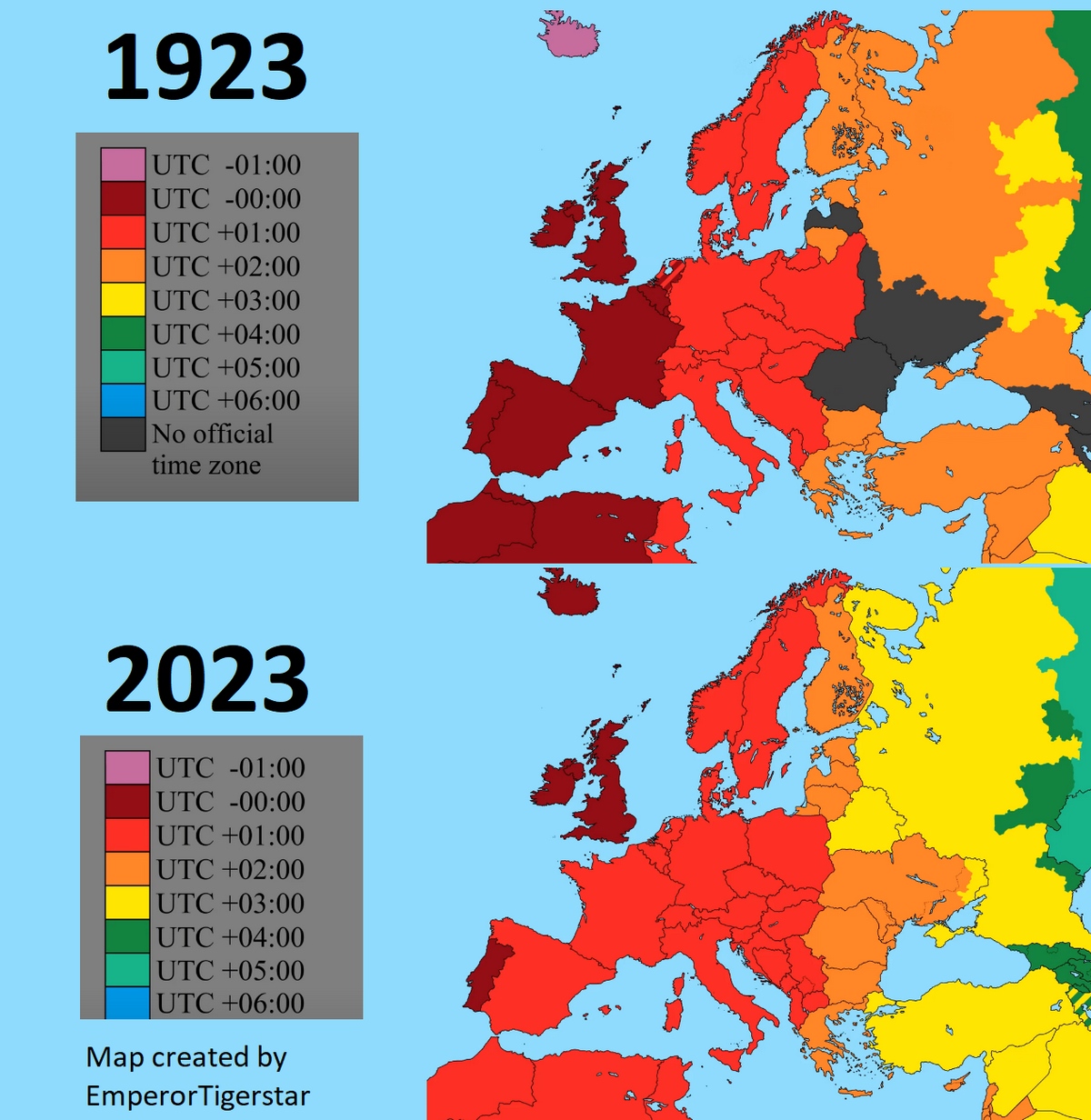
Exactly, here in Spain we have lunch between half past 2 and half past 3 on workdays, which can extend up to 5pm in the weekend and I usually finish dinner at half past ten.
Why? because they decided to be on the same timezone as our eastern neighbors in Europe.
The eastern part of Polonia is on the same timezone and probably have probably the opposite with much much earlier lunch and dinner than we do.
The timezone centered across Görlitz made a lot of sense for the German empire, because it was nearly in half longitude wise and 15° away from Greenwich. It is still somewhat centered in Europe. If you wanted to divide it again, you would need to decide whether the border should be between Germany and France or France and Spain. If you place it between Germany and France, which side will the BeNeLux countries be on? France still has some parts that are nominally in +1 and we don't want to disturb the German-French "friendship", so maybe place it between Spain and France, where there is at least a mountain border? Would that be acceptable? Railways connections between Spain and France are also much less and concentrated than between Germany and France.
Farmers don't care about clocks, they do the work whenever needed. Roosters crow whenever they want. There's literally no point in talking about farmers in this debate.
I took a bunch of film classes in college and what they’re not mentioning is that sometimes the films bring assigned are crazy boring. I once had to watch an hour of footage shot from a camera in an outdoor elevator as it went up and down. One hour. The professor said it was the perfect summation of everything he’d been discussing over the term. I swear I’m not joking.
Perhaps as a film student you were meant to be looking at the composition, the shot structures, the color grading, the use of sound? The film may have been boring in its message or story but still a technical masterpiece?
Isn’t the more fundamental question why Europe has not been as successful as the US or China in building a native tech industry despite having a huge market? What are the barriers to creating startups and how can you lower them and preserve the enviable European social model? Solve that and you’ll solve the problem of a native cloud.
In global economies, it is a general rule that different regions of the world specialise in their respective sectors. In the IT industry, we generally observe that early innovators can extend their advantage by binding customers to their technology platform. One example of how this also applies to Europe in the IT sector is SAP. Founded in 1972, they were one of the first companies to offer ERP solutions. Their founders initially worked at a German branch of IBM and took over a software product that IBM was no longer interested in. SAP's leading position in this market has been so strong ever since that no US company has been able to pose a threat to SAP. Oracle, for example, has tried.
You can see this mechanism at work in the USA itself. Microsoft tried to get into the mobil market, but gave up. Google tried to build its own social network, but gave up. All other cloud providers are stuggeling to catch up with AWS.
Brain drain to USA, lack of good VC / funding, Patents war / patents controlled by the USA, industry espionage, EU mentalities that don't favor innovation in the same direction than the USA, too diverse markets to serve, distributed controls / governments / decisions. The list can go on and on
> Isn’t the more fundamental question why Europe has not been as successful as the US or China in building a native tech industry despite having a huge market? What are the barriers to creating startups and how can you lower them and preserve the enviable European social model? Solve that and you’ll solve the problem of a native cloud.
IMO here in the UK we are good at starting tech startups, we are just bad at not selling them to overseas investors early in their life, or having a tax framework that is advantageous to them growing in the UK.
In the UK see Google Deepmind, ARM, Deliveroo... Elevenlabs being incorporated in the USA, Dyson moving to singapore etc - Even outside of the tech space, Cadburys, Sainsbury's, Jaguar Land Rover... If the UK kept hold of everything that the UK created, we would be great!
Even our infrastructure we sell to the French, Chinese, Germans etc just for short-term gain, despite that we are cutting our nose off if we look forward 10 years.
I am just speculating, but Europe has let itself be very dependent on USA for many things - military/defence, technology etc. "We don't need weapons, USA builds them for us". There has been no need to try and compete.
This is changing now. So maybe the incentives will now appear more clearly.
You don’t have to, this ja the reason. There were multiple successful EU alternatives that were killed by the loads of money the US companies could muster to kill or hobble them. And Europe decided it was fine.
There isn’t even an European card brand that operates across the whole continent, the just accepted to use visa and Mastercard for everything. I hope they change it.
And several European countries had their own card systems. The banks have just decided that letting US companies do the work is more lucrative. It was definitely cheaper and it was necessary if they want to be part of US hegemony network and trade with Asian countries since many of them had bad relationships due to colonialism.
The local card systems still exist in most places, but they only work if you have a card from that country, for people travelling across Europe its useless as once you cross the border people won't accept that card anymore and you're back to taking only visa/mastercard.
Eurocheque existed for a long while for Europe: https://en.wikipedia.org/wiki/Eurocheque . But yes, trusting the US economic and political partnership and also choosing the cheaper option, the European banks eventually decided to not do the legwork of establishing a (global) payment network and settled on American Visa and Mastercard networks.
The divergence of being many smaller countries with different regulations, primary languages, currencies etc have been a blocker, but progress is being made[1] and it seems like people are aware of the problem. It just takes a while when every plan needs to be approved by all countries.
No need, it was much more comfortable to stay in known sectors such as banking, industry or tourism. Now there is a real need so I'm positive things will change.
Let me start with saying I'm all for the European social model, which is sadly regressing. However, this model/system is often a hurdle for start-ups, or any small company for that matter. The rules are designed to regulate big companies also apply to start-ups, adding up a bug overhead in the initial years. I think agriculture specifically is outside most of these regulations, because European countries love their agriculture, i.e. rural votes coming from the farmers.
Talent pool in EU is large but not concentrated like in US. Combine this with every EU country having different rules, and not being able to hire across EU without incirporating in every country you want to hire, it's also challenging to access to the large talent pool.
Well, at the early stages, yes. But at the point where incumbent tech firms have an insurmountable advantage, just adding more startups probably isn't going to save you. Entrenched providers can use their market power to buy up/outcompete/destroy any smaller competitors. You really need both a native market and a startup scene.
China has a huge population that mostly speaks Mandarin. The US has a smaller, but relatively wealthy population that mostly speaks English. Europe is a hodgepodge of languages, cultures, and regulatory environments. That’s a beautiful thing, but it’s not an efficient thing from a business perspective.
Isn’t the whole point of Hamlet that he does have control over his life? At any moment he could have just stabbed Claudius and taken over. The dramatic tension comes from him being unable to get out of his own head and get down to businessto.
I think people need to chill out on this thread. LLMs are neither pure slop nor the end of the programming profession. They are immensely useful tools, particularly for tedious tasks or for quickly getting up to speed on a new API or syntax. They’re great for catching bugs too. Every now and again I’ll give an LLM a prompt and it will knock it out of the park, but that’s exceedingly rare. Most of the time, though, it just allows me to focus on the more interesting parts of my job. In short, for now at least, it is a big productivity booster, not a career ender.
Couldn’t agree more. This is actually a super useful feature. I can’t think of how many times I’ve been reading a book and some minor character resurfaces and I’m like, who the hell is that guy? Now I can know. I can also get information on historical context. Who knows, maybe I can finally read Ulysses without having to have 5 other books.
You could just give more time on tests such that it isn’t worth gaming the time limit. Aren’t we supposed to be teaching subject matter? Why do we care how quickly people can do it? If you’re worried about dumbing things down too much, make the actual content harder. Given how much grade inflation there is, I don’t understand why anyone would be gaming anything anymore anyway. And let’s be honest. Unless you’re trying to get a PhD, your grades don’t matter.
If we don't care about time and only care about eventual recitation of the subject matter, why don't we give all of the students more time instead of only some of them?
The whole conceit of only giving some students more time suggests that timed performance is supposed to matter.


reply